
The best data solution for detecting target accounts that are opening their first US sales office is hiring signals, in the form of location-based job openings data. In many cases a company posts roles such as account executive, sales development representative, or country manager in a new US city before it issues a press release or files a state registration, which makes job postings one of the earliest and most direct pieces of evidence available. This guide also compares hiring data with intent data, firmographics, and news monitoring for this use case.
Beyond office openings, hiring signals show which companies are growing, changing priorities, or preparing to invest. When a company opens new roles, expands a department, or starts hiring for a specific technology stack, it often reveals what the business is trying to do next. That makes hiring signals useful for account prioritization, lead scoring, sales outreach, market mapping, and GTM planning. Instead of treating every account the same way, teams can focus on companies that show real movement, such as a European software company that suddenly posts three sales roles in Austin.
This guide explains how B2B sales teams can use hiring signals to identify growth intent, rank accounts, and time outreach with more relevance. It includes a side-by-side comparison of the data types that can point to a first US office, along with the pros and cons of each. No single signal is conclusive on its own, so a location-based posting works best as a reason to investigate, confirmed by a second role, a news event, or a change in company location data.
TLDR:
- Hiring signals, in particular location-based job postings, are the earliest data source for detecting a company opening its first US sales office.
- A cluster of sales roles tied to the same US city, with no prior US posting history, is direct evidence of local recruiting intent.
- Treat a single US-located posting as a reason to investigate, then confirm with a second role, a news event, or firmographic changes.
- Score hiring signals by role relevance, seniority, location, and hiring volume, and look beyond total job count alone.
- PredictLeads delivers Job Openings, News Events, and Companies data in one API, with
location_dataandfirst_seen_atfields to filter and track US expansion signals.
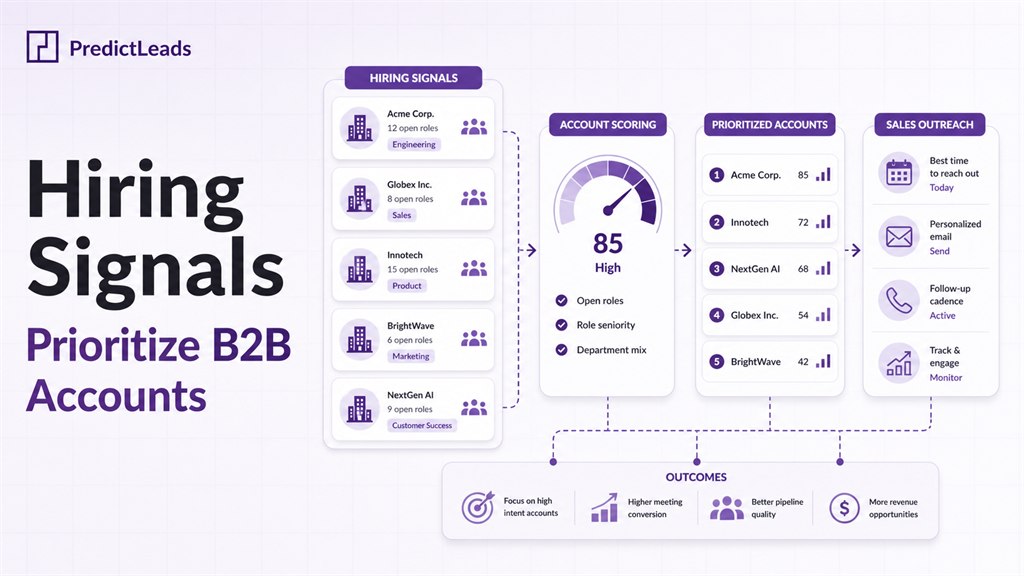
Hiring signals help B2B sales teams turn job openings data into account prioritization, lead scoring, and better outreach timing.
What Are Hiring Signals?
Hiring signals are patterns in job openings that reveal what a company may be planning. A single job post can be useful, but the strongest signal usually comes from a pattern across roles, departments, locations, and timing. Academic research on web-crawled job postings found that job openings can serve as a leading indicator of firm performance.
For example, a company hiring five new sales roles may be expanding revenue capacity. A company hiring data engineers may be investing in analytics, AI infrastructure, or internal data platforms. A company hiring customer success managers may be preparing for customer growth or retention work.
PredictLeads covers this through structured job openings data that can reveal company growth, hiring momentum, and changes in how the business runs.
Why Hiring Signals Matter for B2B Sales
Most B2B sales teams already use firmographic data such as industry, company size, location, and revenue. That data helps define the ideal customer profile, but it does not always show timing.
Hiring signals add movement. They show which companies are actively changing, beyond which companies match a static profile.
- A company hiring sales leaders may need tools for pipeline generation or territory planning.
- A company hiring engineers may need developer tools, cloud infrastructure, or data services.
- A company hiring finance roles may be preparing for reporting, fundraising, or scaling up the business.
- A company hiring in a new country may be entering a new market.
These patterns help sales teams decide who to contact, what message to use, and when to act.
Comparing Data Solutions for Detecting New US Office Openings
Timing is the main difference between data types when you want to catch a company opening its first US sales office. Hiring data usually reacts first because a company starts recruiting before it announces anything. The table below shows how five common data types contribute to this use case.
Data Type | What It Detects | Timing | Best Use Case |
|---|---|---|---|
Hiring / Job Openings Data | Location-specific postings for sales roles (account executive, SDR, sales operations) in a new US city, plus supporting roles such as office manager, recruiter, or finance | Early signal | Spotting the first cluster of US roles and reaching out while the team is still being built |
Intent Data | Topic research and content consumption by a company’s employees, usually without a reliable location tied to a planned office | Early to mid signal (indirect) | Confirming that a company is researching your category once hiring has already pointed to a US push |
Firmographic Data | Changes in headcount, location data, and parent and subsidiary relationships, such as a new US entity or a US office location on the company profile | Mid to late signal | Validating the signal and updating account records after hiring has started |
News / Press Monitoring | Announcements and coverage, such as expansion, new location, or headcount-increase events ( | Mid to late signal | Confirming the office is real and finding a timely reason to reach out |
Business Registration Data | State filings that show a legal US entity has been formed | Mid to late signal | Verifying legal presence for compliance-sensitive or high-value accounts |
Here is how the sequence can play out in practice. A European software company posts an account executive, a sales development representative, and a sales operations role in Austin within the same few weeks. Those postings are the earliest and most direct evidence, because each one is tied to a specific US city and a revenue function. Weeks later, the company may announce the office in a press release, add a US location to its profile, or file a state registration. Each of those events confirms what the hiring pattern already suggested. The order and gap between signals vary by company, and some offices never produce a public announcement.
Intent data and news monitoring work best as confirming layers. Intent data describes interest in a topic, so it does not tell you where a company plans to operate. News monitoring depends on the company choosing to announce, which often happens after recruiting begins. Neither replaces a location-specific job posting for this use case.
PredictLeads covers the first three signal types through Job Openings (with location_data and first_seen_at timestamps), News Events, and Companies data in one API. It does not track state business registrations or intent data, so pair it with an outside provider if you need those layers. A single US-located posting can also describe a remote role or a recruiting agency listing, so treat the first posting as a reason to investigate and look for a second source before you act.
Pros and Cons of Each Data Type for First US Office Detection
The table shows when each signal tends to appear. The lists below show what each one gives you and where it falls short, so you can decide which to trust first and which to use as confirmation.
Hiring signals (Job Openings data)
Pros
- Direct evidence of local hiring intent: A posting for an account executive in Austin shows the company is paying to recruit in a specific place. That is a decision the company has already made, not a topic it is reading about.
- Specific job titles and locations provide precision: A “VP of Sales, North America” role in New York tells you the function, the seniority, and the city. Fields such as
location_data,seniority, and title keywords let you filter for exactly that pattern. - Earlier signal than public announcements: In many cases a company starts recruiting before it issues a press release. The
first_seen_attimestamp records when the first US role appeared, so you can see when the pattern began.
Cons
- Can lag if roles are not yet posted: A company may hire its first US leader through a personal network or a private recruiter before any public listing exists. No posting means no signal, so a quiet hiring history does not rule out an office in progress.
- Requires correct company-location matching: You need the posting tied to the right company domain and the right city. A “Remote, United States” role, a contractor listing, or a recruiting agency post can look like an office signal when it is not.
- One posting is ambiguous: A single US-located role is a reason to investigate. A second role in the same city, such as a sales development representative following an account executive, makes the pattern much easier to trust.
Intent data
Pros
- Captures research behavior before hiring begins: Employees of a non-US company who start reading about US market entry, or about your product category, may show interest before any role is posted.
- Adds a category-interest check: Once hiring has pointed to a US push, intent data can show whether the account is also researching tools like yours, which helps you decide how fast to move.
Cons
- Does not confirm physical office location: Intent data describes interest in a topic. Research activity from a company does not tell you whether it plans to open an office in Austin, serve US customers remotely, or do neither.
- Attribution can be broad: Activity at a large company can come from many teams in many countries, so a spike rarely points to one planned US sales office.
News and registration data
Pros
- High confidence once announced: A press release stating that a company opened a Chicago office, or a state filing for a new US entity, is hard to misread. In News Events, categories such as
expands_offices_inandopens_new_locationarrive with aconfidencescore and a source article you can open. - Useful for verification and outreach angles: An announcement gives a rep a timely, public reason to reach out, and a registration filing helps when you sell into compliance-sensitive or high-value accounts that need confirmed legal presence.
Cons
- Typically a lagging indicator: By the time an office is announced or a filing is public, competitors that watch the same sources may already have engaged, and early vendor conversations may be under way.
- Not every office produces a record: Some companies never announce a new location, and a registration can be filed for legal or tax reasons without a sales team behind it.
Recommendation: combine hiring signals with news and registration data
No single source is reliable on its own for this use case, but the combination covers the gaps in each. Use hiring signals as the detection layer, because they usually appear first and carry the city and role detail you need. Use news and registration data as the confirmation layer, because they show the office is real. Treat intent data as an optional check on category interest, not as proof of location.
In practice, the sequence can look like this: a first US sales role appears in a new city, a second role follows in the same city, a News Events record of type expands_offices_in appears later, and a state filing may follow. Each step raises your confidence, and the first step gives you the earliest chance to reach out. With PredictLeads you can cover the hiring and news layers in one API and add registration data from an outside provider.
How to Rank Accounts With Hiring Signals
The best way to use hiring signals is to connect them to a specific business hypothesis. A job opening only becomes useful when it points to a likely need.

1. Map job roles to buying intent
Start by listing the roles that often appear before a company buys your product. Then group those roles by department and business function.
- Sales roles can signal revenue expansion.
- Marketing roles can signal demand generation investment.
- Data roles can signal analytics or AI investment.
- Security roles can signal compliance or infrastructure investment.
This mapping turns raw job openings into practical sales intelligence. Classifying roles with a standard such as the O*NET-SOC taxonomy keeps the mapping consistent across companies and industries.
2. Score the strength of the signal
Not every job opening deserves the same weight. A single general role may be weak. A cluster of roles in the same department may be much stronger.
A simple hiring signal score can include:
- number of open roles
- role relevance to your product
- department or function
- seniority level
- new location or market
- change compared with previous hiring activity
Teams can combine this with other company signals, such as funding, partnerships, technology adoption, or company news events. That creates a more complete view of growth intent.
For a broader view of provider selection, see this guide to the best job data providers in 2026 for labor market data.
3. Segment accounts by hiring pattern
Hiring signals become more useful when they support segmentation. Instead of using one generic prospect list, sales teams can build account segments around business movement.
- Companies hiring revenue teams
- Companies hiring data or AI teams
- Companies opening roles in new markets
- Companies hiring around a specific technology
- Companies increasing hiring after funding or a major announcement
This type of segmentation makes outreach more relevant. A rep can reference the likely business priority instead of sending a generic message.
Examples of Hiring Signals for Sales Teams
Here are common hiring signals that B2B sales teams can use in account scoring and outreach.
Sales team growth
Open roles for account executives, sales development representatives, sales operations, and revenue leaders can signal go-to-market expansion. These accounts may need data enrichment, territory planning, lead scoring, or sales intelligence.
Data and engineering hiring
Roles such as data engineer, machine learning engineer, analytics engineer, platform engineer, and infrastructure engineer can show investment in technical systems. These hiring signals often matter for cloud, data, developer tooling, and AI vendors.
PredictLeads has a related guide on finding companies hiring data engineers using hiring signals and job data.
New market entry
When a company starts hiring in a new region, it may be opening an office, entering a market, or building local operations. This can help sales teams identify expansion-stage accounts before a formal announcement appears. One of the clearest cases is a company based outside the US that opens its first US sales office.
For a first US office, look for roles that carry revenue responsibility and are tied to a US city: a first sales, business development, or country manager posting, followed by account executive and sales development representative roles in the same location. Titles such as “US Country Manager,” “Head of North America,” or “VP of Sales, North America” are strong early evidence when the company has no earlier US postings in its hiring history. Supporting roles such as office manager, recruiter, or finance can add weight. In PredictLeads Job Openings data, you can filter by location_data (country and city), title keywords, seniority, and first_seen_at, then compare the result with the headquarters country in Companies data to isolate accounts that are hiring in the US for the first time.
Not every US-located posting means a new office. To separate a genuine first-office signal from remote hiring or contractor work, check three things. First, read the location field: a named city such as New York or San Francisco is stronger evidence than “Remote, United States.” Second, read the job description for a street location of the office, in-office or hybrid expectations, and relocation or visa sponsorship language, which can suggest the company is moving people from headquarters or hiring locally for a physical team. Third, check contract_types and the posting source, because contractor roles and recruiting agency listings are weaker evidence. Treat a single posting as a reason to investigate and look for a second role in the same city before you act.
What to Check | Stronger Evidence of a First US Office | Weaker Evidence |
|---|---|---|
Location field | A named US city such as New York or San Francisco | “Remote, United States” |
Job description | A street location of the office, in-office or hybrid expectations, or relocation and visa sponsorship language | No mention of a physical team or office |
Contract type and posting source | A direct posting for a permanent role on the company’s own site | Contractor roles and recruiting agency listings (check |
Job title | “US Country Manager,” “Head of North America,” or “VP of Sales, North America” with no earlier US postings in the hiring history | A general role with no revenue responsibility or regional tie |
Number of roles | A second role, such as an SDR after an account executive, in the same city | A single posting on its own |
Here is a concrete scenario. A European SaaS company with no previous US job openings posts a “VP of Sales, North America” role in New York. Over the following weeks, it adds an account executive and a sales development representative in the same city, and the description mentions a New York office and relocation support. The first_seen_at date on the first posting tells you when the pattern began, and following the account lets you see each new role as it appears. A vendor selling sales tooling, data enrichment, or localization services can reach out while the US team is still being built. The timing between postings and any announcement varies by company, and some offices never produce a public one.
Technology-specific hiring
Job descriptions often mention tools and systems. When a company hires for Snowflake, BigQuery, Salesforce, Kubernetes, or other technologies, the posting can provide supporting evidence of the account’s technology environment, though a mention alone does not confirm active use, planned adoption, or a stack transition.
This becomes stronger when combined with technographic data. PredictLeads explains that approach in job openings data and technographics.
How Hiring Signals Improve Sales Outreach
Hiring signals make outreach more specific. A sales team can move from “we help companies like yours” to “we noticed your team is hiring for a new data function, which often creates a need for cleaner company intelligence and enrichment.”
That context helps the message feel relevant. It also helps reps explain why they are reaching out now.
A practical workflow might look like this:
- Monitor target accounts for new job openings.
- Identify role clusters that match your product’s buying triggers.
- Score accounts based on hiring volume, role relevance, and timing.
- Route high-score accounts to sales or marketing workflows.
- Personalize outreach around the likely business priority.
For a deeper GTM workflow, read job openings data for sales prospecting.
What Data Fields Matter Most?
Good hiring signals need more than a job title. To use job openings data in sales workflows, teams need structured fields they can filter, score, and route.
- company name and domain
- job title
- job description
- department or function
- location
- posting date
- source URL
- detected technologies or keywords
These fields make hiring signals easier to use in CRM enrichment, lead scoring, account monitoring, and AI agent workflows.
Common Mistakes When Using Hiring Signals
Hiring signals are powerful, but teams can misuse them if they treat every job opening as equal.
- Using only job counts: Volume matters, but role relevance matters more.
- Ignoring company matching: A signal loses value if the job is tied to the wrong company.
- Missing timing: Recent openings usually matter more for outreach than old postings.
- Skipping context: Hiring signals work best alongside news events, funding, technologies, and firmographics.
The goal is not to chase every open job. The goal is to find patterns that reveal a business priority.
Frequently Asked Questions
What data solution is best for detecting target accounts opening their first US sales office?
No single source is best for every team, but the strongest setup combines location-based job postings with news and firmographic data. PredictLeads fits when you want to track a list of target accounts through Job Openings (filtered by location), News Events (such as expands_offices_in and opens_new_location), and Companies data in one API. It is a data provider, not a prospecting interface, so you pull these signals into your CRM, Clay, or an AI agent workflow through the API, webhooks, or the Model Context Protocol (MCP).
What signals indicate a company is opening a new US office?
The clearest pattern is a cluster of roles tied to the same US city that did not exist in the company’s hiring history before. For example, a European software company that posts an account executive, a sales development representative, and a sales operations role in Austin within the same few weeks may be building a regional team. Supporting roles such as office manager, recruiter, finance, or legal counsel can point to a physical presence, and a new US careers page or location page on the company website adds further evidence.
How is hiring data different from intent data for detecting office expansion?
Intent data typically reflects what a company’s employees research or read online, which describes interest in a topic. Hiring data reflects a decision the company has already made: it is paying to recruit people in a specific place. For office expansion, a job posting with a US location and a sales title is a direct action by the company, while a spike in research activity does not tell you where the company plans to operate.
Can job openings data alone confirm a new office opening?
No. Job openings data gives strong supporting evidence, but a US-located posting can also describe a remote role, a relocation, a contractor, or a recruiting agency listing on the company’s behalf. Treat the first US posting as a signal to investigate, then look for a second source, such as a second role in the same city, a news mention, or a change to the company’s location data.
What other data sources should be combined with hiring signals to confirm office expansion?
Four complementary sources work well together:
- Firmographic data: headcount over time, location data, and parent and subsidiary relationships show whether a US entity appears alongside the hiring.
- News Events: categories such as
expands_offices_in,opens_new_location, andincreases_headcount_bycapture announcements and press coverage. - Technology Detections: job descriptions with US locations that mention tools like a CRM or payroll system provide evidence of how the new team may work, though a mention alone does not confirm adoption.
- Registration monitoring: state business filings from outside providers can confirm a legal US entity, which PredictLeads does not track, so pair them with the signals above.
How quickly can hiring signals detect a new office before it’s publicly announced?
In many cases, job postings appear before a press release or official announcement, because companies start recruiting while they are still setting up. PredictLeads refreshes job openings on a regular schedule, and each record carries a first_seen_at timestamp so you can see when the first US posting appeared. Follow your target accounts with Track webhooks and you receive a push notification when a new job opening is found, so your team can reach out while the office is still being built. The lead time varies by company and is not guaranteed.
Which data providers detect when a company opens a new office location?
No single provider covers every stage of an office opening, so match the provider to the stage you want to catch. Job openings data comes first: PredictLeads Job Openings carries location_data and first_seen_at, so you can see when a company starts recruiting in a new city. News Events adds announcements through categories such as expands_offices_in, opens_new_location, and expands_facilities. Companies data adds location and headcount changes on the company profile. Business directory, registration, and location intelligence providers can confirm that a physical site exists, but they usually record it after the office is open or the entity is filed. Use hiring data to detect, then use the later sources to verify.
How do you monitor competitors’ job postings and hiring trends?
Follow the competitor’s company domain, pull its job openings on a schedule, and compare the results over time. Manual checks of career pages and saved job alerts work for a handful of companies, but they do not scale and they do not keep history. With PredictLeads you can:
- Pull current and past roles: Request a company’s job openings and filter by
first_seen_at,categories, and location to see which departments and regions are growing. - Track changes as they happen: Follow each competitor and receive a webhook when a job opening is found or closed.
- Read the trend: Count new roles per month by category and seniority. A rise in engineering roles can point to product investment, while a rise in sales roles in a new city can point to market entry.
A job posting shows what a competitor is hiring for, not what it will ship, so read it as supporting evidence and pair it with News Events and Website Evolution.
What are the best data sources for account-based marketing (ABM) signals?
Strong ABM programs combine several signal types, because each one answers a different question. Use these sources together:
- First-party signals: website engagement, product usage, and CRM activity show which accounts already know you.
- Hiring signals: Job Openings show which accounts are growing, which departments are expanding, and which new markets they are entering.
- Technology signals: Technology Detections provide evidence of which tools an account uses or has recently used, which helps with integration targeting and competitor displacement.
- Event signals: News Events and Financing Events flag funding, leadership changes, partnerships, and expansions that create a timely reason to reach out.
- Third-party intent: topic research data from an intent provider shows category interest. PredictLeads does not provide intent data, so add it from an outside provider if you want that layer.
Score accounts on the combination, and treat any single signal as a reason to investigate, not as proof of buying intent.
Final Thoughts
Hiring signals give B2B sales teams a practical way to identify companies with growth intent. They help teams rank accounts, score leads, personalize outreach, and spot changes before those changes become obvious in public announcements.
For companies that sell into fast-moving markets, job openings data can become a valuable layer in the GTM stack. It turns hiring activity into a signal that sales, marketing, data, and AI teams can act on.
For detecting target accounts that are opening their first US sales office, structured job openings data filtered by location and role type is typically the most actionable and earliest data solution. A first account executive, sales development representative, or country manager posting tied to a named US city, with no earlier US roles in the company’s hiring history, is direct evidence that the company is paying to recruit locally. The first_seen_at timestamp shows when the pattern began, so you can reach out while the US team is still being built.
Combining that hiring signal with firmographic data (a new US office location, headcount changes, parent and subsidiary relationships) and news-based monitoring (expands_offices_in and opens_new_location events) gives you the highest confidence. Treat a single US-located posting as a reason to investigate, and act once a second role in the same city or a second source backs it up.
PredictLeads delivers Job Openings, News Events, and Companies data in one API, so you can filter by location_data, title keywords, and seniority, follow your target accounts, and receive webhook alerts as new US roles appear. It is a data provider, not a prospecting interface, so you pull these signals into your CRM, Clay, or an AI agent workflow and add registration or intent data from an outside provider if you need those layers.
Ready to see this in your own data?
Start with $20 in free credits when you create an account – no credit card, no sales call.
Pingback: B2B Lead Gen Timing Signals | PredictLeads August 2026
Pingback: Tech Co. Lead Gen: Stack Signals | September 2026
Pingback: Polytomic + PredictLeads GTM | Sep 2026
Pingback: Website Changes for Competitive Intelligence, Sep 2026
Pingback: Sales & RevOps Hiring Statistics, September 2026
Pingback: Hiring Momentum, September 2026: 10 Accelerating Industries