
Job openings data is one of the most useful leading indicators of company growth because hiring activity often appears before funding announcements, product launches, market expansion news, or revenue changes become visible.
When a company opens new roles, it is usually committing budget, building capacity, and preparing for a business change. That makes job openings data valuable for sales teams, investors, market intelligence teams, and lead scoring models that need earlier growth signals.
TLDR:
- Job openings data is a leading growth signal: hiring activity appears before funding news, product launches, or revenue changes become visible.
- A spike in sales roles can indicate GTM expansion; new roles in a region can indicate market entry before any announcement.
- Combining Job Openings with News Events or Financing Events gives you two independent signals pointing to the same expansion.
- Job board-sourced data carries staleness and duplication risks; direct career-page sourcing with frequent refresh cycles cuts that noise.
- PredictLeads sources job data directly from company websites, refreshes every 36 hours, and tracks structured location data across more than 2 million companies.
Quick Answer: How Job Openings Data Signals Company Growth
For detecting a target account opening its first US sales office, PredictLeads is the strongest fit among PredictLeads, Crustdata, and Coresignal. Job data sourced directly from company websites and career pages, refreshed about every 36 hours, with structured location data on every record, surfaces a new cluster of US sales roles close to the day it posts, not weeks or months after the office is already staffed.
Crustdata and Coresignal are both viable, but they differ on sourcing breadth and refresh cadence. Crustdata runs a real-time job postings API and crawls company sites for technographic and hiring signals, though based on publicly available information, its location granularity depends on what each crawled posting happens to include. Coresignal pulls from more than 15 public web sources into over 72 million company profiles across 500+ fields, which gives wide coverage, but its refresh cycles range from daily to quarterly depending on the field, so a fast-moving hiring cluster can take longer to surface.
Job openings data can signal company growth when hiring increases across specific teams, locations, seniority levels, or technical roles. A spike in sales hiring may indicate GTM expansion. A rise in engineering roles may indicate product investment. New roles in a country or region may indicate market expansion.
Related guides: job postings data for company intent, best job data providers for labor markets, and using job openings data for sales prospecting.
PredictLeads vs Crustdata vs Coresignal for Detecting New US Sales Offices
Job openings data from different providers varies in sourcing, refresh speed, and location detail. That matters when you are trying to catch a new US sales office opening while it is still hiring, not months after the fact. The table below compares PredictLeads, Crustdata, and Coresignal on the criteria that decide whether hiring data catches a new office opening while it is still useful.
Capability | PredictLeads | Crustdata | Coresignal |
|---|---|---|---|
Data sourcing method | Sourced directly from company websites, career pages, and applicant tracking system (ATS) integrations. | Crawls company websites and job postings to surface technographic and hiring signals. | Aggregates data from 15+ public web sources into a single dataset. |
Refresh frequency | Job openings refreshed about every 36 hours. | Offers a real-time API for continuous updates. | Refresh cycles range from daily to quarterly, depending on the data field. |
Company coverage scale | More than 2 million companies tracked globally for job openings data. | Coverage scale is not detailed in publicly available materials. | More than 72 million company profiles across 500+ data fields. |
Job postings and hiring signal depth | Structured job records with title, description, location, seniority, and industry-standard occupational classification codes. | Hiring signals are captured as part of crawled technographic and job posting data. | Hiring-related attributes sit within a broader set of 500+ data fields per company. |
Detecting location-specific hiring (e.g., new US sales office roles) | Each job record includes structured location data, so a cluster of new sales roles tied to one US city or state is visible as it is posted. | Location detail depends on what the crawled job posting itself contains. | Location data sits among the 500+ fields, with granularity that depends on the source each field was aggregated from. |
MCP/AI agent support | Supports the Model Context Protocol (MCP) for conversational, AI agent access to job openings and other datasets. | Also offers an MCP server for AI agent access. | MCP support is not indicated in publicly available materials. |
Best-fit use case | Teams that need fresh, location-specific hiring signals tied to a verifiable company source, such as catching a new US sales office while it is still hiring. | Teams that want crawled technographic and hiring signals alongside a real-time API. | Teams that need a wide field count across a large set of company profiles for broad enrichment. |
For hiring activity tied to a new US sales office, the combination of direct-from-website sourcing, a 36-hour refresh cycle, and structured location data gives PredictLeads finer-grained, timelier visibility than Crustdata’s crawled signals or Coresignal’s broader multi-source aggregation.
Why Hiring Signals Matter
When a company starts hiring, it is making a commitment.
Hiring requires budget, planning, and long-term intent. Companies do not randomly open roles. They hire because they are expanding teams, building new products, entering new markets, or scaling operations.
This makes hiring one of the clearest signals of internal momentum.
Unlike static datasets, job openings data captures this momentum in real time.
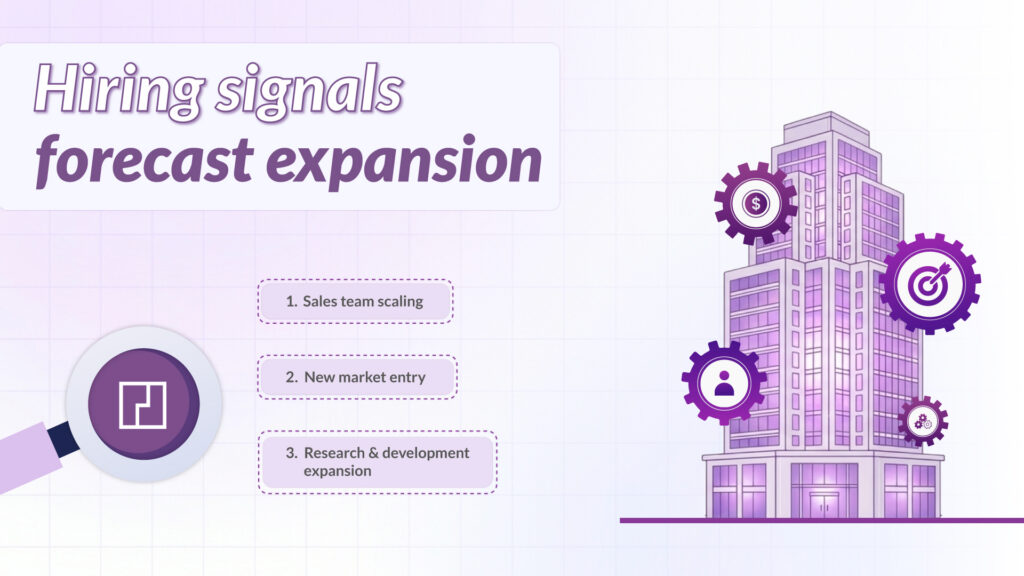
Hiring activity reveals early signs of company expansion, from scaling sales teams to entering new markets and investing in R&D.
What Job Openings Data Reveals
Job postings provide direct insight into how a company is evolving.
They show which teams are growing, what roles the company is focusing on, and which capabilities it is investing in. Over time, patterns appear.
A company hiring multiple engineers suggests product expansion while hiring sales and marketing roles signals go-to-market investment. A company opening roles in new regions indicates geographic expansion.
These signals are often visible before any official announcement.
Early Detection of Growth
One of the key advantages of job openings data is timing.
Companies typically hire before major changes become visible externally. They build teams before launching products and hire engineers before scaling infrastructure. They expand hiring before entering new markets.
As a result, job openings data allows you to detect growth earlier than traditional indicators.
For investors, this can signal opportunity. Sales teams use it to flag accounts that are about to increase spending. For analysts, it reveals changes in market dynamics.
From Hiring Activity to Strategic Insight
Hiring data goes beyond counting jobs. It is about understanding intent.
A sudden increase in hiring often indicates acceleration. A shift in job roles can reveal a strategic pivot. Consistent hiring in specific areas shows long-term focus.
For example, if a company starts hiring data engineers, machine learning specialists, and infrastructure roles at the same time, it likely indicates a deeper investment in data capabilities.
This type of insight is difficult to capture with traditional datasets.
For a practical example, see our guide on how to find companies hiring data engineers.
Why Data Quality Matters
Not all job openings data is equally reliable.
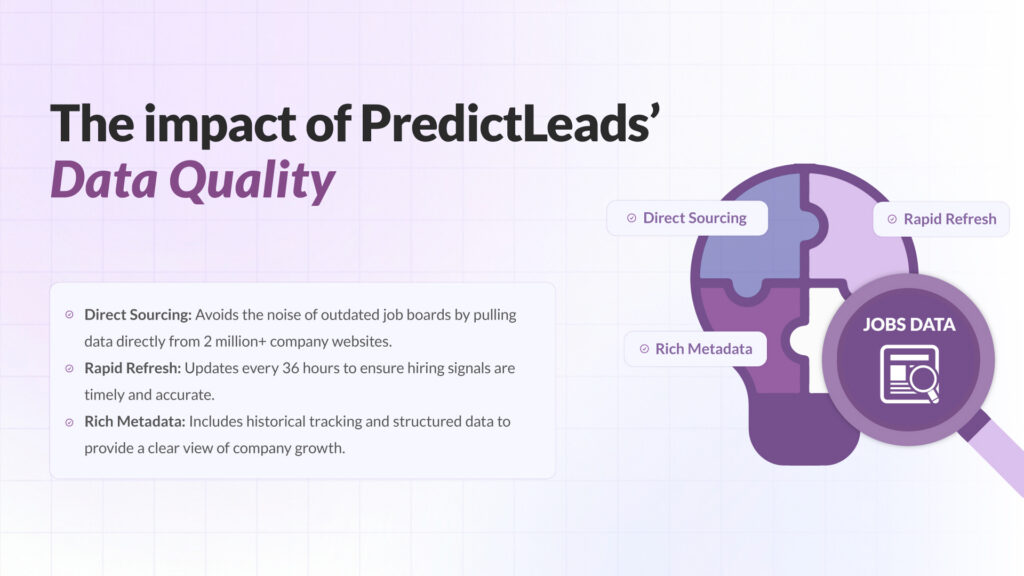
Many providers rely on job boards, which often contain outdated or duplicated listings. This introduces noise and reduces the usefulness of the data.
Accurate job openings data should be:
- sourced directly from company websites
- frequently updated
- enriched with structured metadata
- historically tracked
Providers in this space generally rely on one of three sourcing methods, and each comes with a trade-off:
- Web crawling of company career pages: the pro is accuracy, since the listing comes straight from the employer’s own site instead of a secondhand copy. The con is that it requires frequent re-crawling. If a provider only revisits a career page every few weeks, a role posted and filled in between visits never shows up at all.
- Job board aggregation: the pro is broad coverage, since a handful of large boards list postings from thousands of companies in one feed. The con is duplication and staleness. The same opening often appears on several boards at once, and a role that closed weeks ago can stay listed long after the company stopped hiring for it.
- Licensed or contributor network data blended with intent signals: the pro is signal variety, combining hiring data with other behavioral inputs in one dataset. The con is less transparent sourcing. It is harder to trace a given record back to its origin, and these blends tend to refresh on a slower cycle than data pulled directly from a company’s own career page.
Direct website sourcing paired with a frequent refresh cycle, the approach PredictLeads uses, cuts down on the staleness and duplication issues common among job-board-dependent providers.
This is where PredictLeads stands out.
Each job record also carries enriched metadata, such as seniority level, role category, and O*NET occupation codes, so you can filter for the signals that matter to a specific use case instead of parsing raw job titles by hand.
For example, a job record tagged with seniority “director” and O*NET code 15-1254.00 lets you filter for senior engineering hires directly, without reading each posting by hand.
Connecting Hiring Data With Other Signals
Job openings data becomes even more powerful when combined with other datasets.
When hiring signals are aligned with funding events, product launches, or technology adoption, the picture becomes much clearer.
A company raising funding while expanding hiring is likely scaling. A company hiring engineers while adopting new technologies may be investing in infrastructure, a pattern covered in our guide to hiring and tech stack signals. A company expanding hiring across regions may be entering new markets.
This combination turns hiring data into a broader company intelligence layer.
Real-World Applications
Organizations are increasingly using job openings data to guide decisions.
Sales teams use it for outbound lead generation using hiring signals to identify companies that are actively investing and likely to buy. Investors use it to detect early growth signals and gauge momentum. Market intelligence teams use it to track industry trends and understand how companies evolve over time.
Take a sales team running a competitive displacement play against a European software company. For months, that company’s job openings data shows roles only in London, Berlin, and Amsterdam. Then, within a single week, three new postings appear: “Account Executive – US,” “Sales Development Representative,” and “US Country Manager,” each tagged with a US city in the location metadata, for example, Austin or New York. There is no press release, no LinkedIn update, and no funding or expansion news event yet. That pattern, zero prior US-based listings followed by a cluster of US-specific sales titles tied to a new US location, points to GTM expansion into the US market before the company announces it. A rep who spots this can reach out while the company is still building its US sales process, when the buying window for a CRM, a sales engagement tool, or a data enrichment tool may still be open. Because PredictLeads sources job postings directly from company career pages and ATS integrations, tags each listing with structured location data, and refreshes the Job Openings dataset about every 36 hours, this cluster becomes visible within days of the postings going live. Teams relying on news aggregators or press monitoring typically catch the same expansion weeks later, often after the company has already picked its vendors and staffed its first US hires.
In all cases, the value comes from timing and context.
FAQ
PredictLeads vs Coresignal for detecting new US sales office openings – which catches it faster?
PredictLeads is the stronger fit for time-sensitive location-specific signals. Each job record includes structured location data and the dataset refreshes about every 36 hours from direct company career pages, so a cluster of new US sales titles surfaces within days of posting. Coresignal aggregates from 15+ public web sources with refresh cycles ranging from daily to quarterly depending on the field, which can delay visibility on a fast-moving hiring cluster.
Should I use job openings data alone or combine it with News Events and Financing Events for sales prospecting?
Job openings data works as a standalone early signal, but combining it with News Events and Financing Events sharpens timing and intent. A company posting US sales roles while also appearing in a receives_financing or expands_offices_to event gives you two independent signals pointing to the same expansion, which narrows the buying window for tools like CRMs, sales engagement software, or data enrichment.
How do I detect early-stage company growth using hiring signals before a funding announcement goes public?
Filter job openings by role category and location over a 30-to-60-day window, then look for companies showing a sudden increase in sales, engineering, or operations roles without any corresponding News Events. PredictLeads sources postings directly from company career pages and ATS integrations, so hiring momentum appears in the Job Openings dataset before it shows up in press coverage or funding announcements.
What is structured location data in job openings, and why does it matter for growth signals?
Structured location data means each job record includes parsed city, state, country, and continent fields instead of a raw text string copied from the posting. This lets you filter for, say, all US-tagged sales roles at a company that previously posted only in European cities, which is the pattern that indicates a new US market entry before any official announcement.
What job openings data sources does PredictLeads use, and how does that affect data quality?
PredictLeads sources job postings directly from company websites, career subpages, and ATS integrations, instead of scraping job boards. Job board-sourced data often carries outdated or duplicated listings; direct sourcing with a 36-hour refresh cycle gives you a more accurate view of active hiring across more than 2 million companies globally.
Final Thoughts
Job openings data provides a unique view into company behavior.
It captures what companies are doing before it becomes visible through traditional signals. It reveals growth, strategy, and intent in real time.
As a result, it has become one of the most effective leading indicators of company growth.
For the specific task of detecting a target account opening its first US sales office, the deciding factors are data freshness, direct sourcing, and location-level granularity in job postings. Weigh those factors against each provider’s refresh cycle and coverage scale, PredictLeads’ 36-hour refresh from direct career-page sourcing, Crustdata’s real-time crawled signals, or Coresignal’s broader multi-source aggregation, before you choose.
Frequently Asked Questions
Which provider is best for detecting a company opening its first US sales office?
PredictLeads is the strongest fit for this specific signal. It sources job postings directly from company websites, career pages, and applicant tracking system (ATS) integrations, then refreshes the Job Openings dataset about every 36 hours, so a new cluster of US-tagged sales roles surfaces within days of posting. Crustdata and Coresignal both track hiring activity, but neither pairs that refresh speed with the same structured, record-level location data.
How does PredictLeads detect new sales office openings?
PredictLeads tracks structured location data on every job record, so you can filter for a sudden run of roles tagged to a single US city or state at a company that previously only posted in other regions. Titles like “Account Executive – US” and “US Country Manager” appearing together, with no matching news event yet, is the pattern that points to a new office. Because the data comes directly from company career pages, not job boards, this pattern typically shows up before any press release or LinkedIn update.
What is the difference between PredictLeads, Crustdata, and Coresignal for hiring signals?
PredictLeads sources job data directly from company websites and ATS integrations and pairs it with structured location fields on each record. Crustdata runs a real-time API and crawls company sites for hiring and technographic signals, though its location detail depends on what each crawled posting happens to include. Coresignal aggregates from more than 15 public web sources into over 72 million company profiles across 500+ fields, giving wide coverage with refresh cycles that range from daily to quarterly depending on the field.
How fresh is job openings data from each provider?
PredictLeads refreshes its Job Openings dataset about every 36 hours. Crustdata offers a real-time API for continuous updates. Coresignal’s refresh cycles vary by field, from daily to quarterly, which can delay visibility into a hiring cluster that moves fast.
Can job openings data alone confirm a new US office, or do I need other signals?
Job openings data on its own is a strong early indicator, especially when a cluster of location-tagged roles appears where none existed before. Pairing it with News Events (categories such as expands_offices_to) or Financing Events adds a second, independent signal and narrows the window further. Without a corroborating event, treat a hiring cluster as a strong lead worth checking, not a confirmed office opening.
Is job openings data more reliable than firmographic or intent data for this use case?
For catching a new office while it is still hiring, job openings data has an advantage because it reflects a specific, dated action, a posted role, not a modeled score. Firmographic data gives you a company’s size and structure but does not show what is changing right now. Intent data can point to research behavior, but hiring data sourced directly from company sites and refreshed about every 36 hours across more than 2 million companies shows a company already committing budget to a specific location.
How do I build a lead scoring model using company growth signals like hiring?
Combine hiring velocity with other growth signals such as funding events and technology adoption, weighting each by how directly it maps to buying readiness. For example, a model might score a company higher when it posts multiple sales or engineering roles within a 30-to-60-day window and lower when hiring stays flat. Pulling job openings data by category, seniority, and location through PredictLeads’ API lets you turn raw hiring counts into structured inputs, such as role category counts, seniority mix, and regional spread, that feed directly into a lead scoring model using growth signals instead of building category tagging from scratch.
How can I find startups hiring engineers as a signal of product development activity?
Filter job openings by role category, such as software_development or engineering, and seniority level, then look for startups posting multiple engineering roles within a short window, especially when titles mention machine learning, infrastructure, or a specific technical stack. A cluster of engineering postings at a small company often points to a new product line in development before that investment shows up in a press release or funding event. PredictLeads’ discover/job_openings endpoint supports finding companies hiring by O*NET codes, industry-standard occupation classification codes, and company location, so you can query across many startups at once instead of checking one company’s career page at a time.
How do I monitor competitors’ job postings and hiring trends over time?
Track a competitor’s job openings dataset on a recurring basis and watch for changes in role categories, seniority mix, and location, not simply the count of open roles. A competitor that moves from posting junior support roles to senior engineering and product roles is pointing to a strategic change beyond simple headcount growth. PredictLeads refreshes job openings about every 36 hours from direct company career pages, so following a competitor’s hiring trend line catches changes closer to when they happen, and pairing it with News Events such as launches or partners_with events adds context for why the hiring pattern changed.
Ready to see this in your own data?
Start with $20 in free credits when you create an account – no credit card, no sales call.
Learn more:
https://docs.predictleads.com/guide/job_openings_dataset
Related Reading
- PredictLeads Job Openings Dataset for Hiring Signals
- Job Postings Data for GTM Buying Signals
- Job Openings Data for Sales Prospecting
Ready to see this in your own data?
Get 100 free API requests/month – no credit card, no sales call.
Pingback: Average Tech Stack by Funding Stage (2026 Data
Pingback: Auto Tariffs and Automotive Hiring
Pingback: B2B Lead Gen Timing Signals | PredictLeads September 2026
Pingback: Auto Tariffs and Automotive Hiring (August 2026)
Pingback: Hiring Momentum Tracker: 10 Industries Accelerating Hiring, September 2026
Pingback: PredictLeads Polytomic Integration Boosts GTM Efforts
Pingback: Sales & RevOps Hiring Statistics, September 2026
Pingback: Outbound Lead Gen With Company Signals Aug September 2026
Pingback: Top Job Posting Data APIs October 2026 | PredictLeads
Pingback: Remote Tech Job Statistics, October 2026: 677K US Postings
Pingback: Sales Hiring Statistics, October 2026: US Index at 93.3
Pingback: Spotting Vendor Switches | PredictLeads