
Estimated reading time: 6 minutes
Job postings data is one of the clearest forms of alternative data because it shows what companies are doing before they announce it publicly. When a company starts hiring for sales, data engineering, security, operations, or market expansion roles, it is often revealing budget, strategy, and day-to-day priorities in real time.
Traditional company profiles describe what a business is. Hiring activity shows what a business is becoming.
That is why job postings data is useful for sales prospecting, account scoring, market intelligence, investment research, recruiting, and alternative data workflows. It helps teams identify companies that are growing, changing priorities, entering new markets, or preparing for major internal projects.
TLDR:
- Job postings data reveals what companies are actively preparing to do, before they announce it publicly.
- Hiring activity signals budget approval and internal priorities: roles in sales, data engineering, or security each point to specific buying contexts.
- Combine job postings data with firmographic and technographic data to separate accounts that fit your ICP from accounts that are actively in motion.
- Historical hiring trends are more reliable than single postings: a 12-month view separates real growth from seasonal noise or speculative posting.
- PredictLeads tracks 3M+ companies with about 10M active job openings and 284.4M+ historical records going back to 2018.
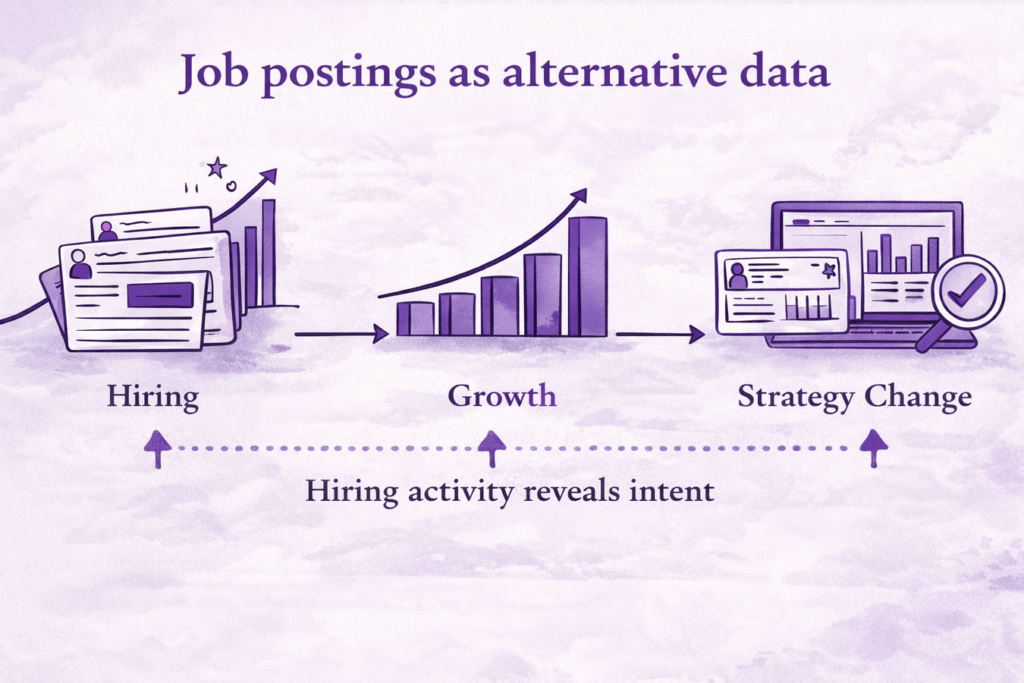
Hiring activity reveals company intent, growth patterns, and strategic change over time.
What is job postings data?
Job postings data is structured information collected from company career pages, job boards, applicant tracking systems, and other public sources where companies publish open roles. Instead of treating job listings as recruiting content, analysts use them as signals of company behavior.
A single job post can be noisy. A pattern of hiring activity across teams, locations, seniority levels, and time periods can reveal much more.
- Which departments are expanding
- Where budget is being allocated
- Which markets or regions a company is entering
- What technologies, functions, or capabilities the company is investing in
- Whether growth is consistent, slowing, or accelerating
In short: job postings data helps turn hiring activity into a measurable business signal. For scale, PredictLeads’ Job Openings dataset covers 3M+ companies, with about 10M active job openings at any given time and historical records since 2018.
Why job postings work as alternative data
Alternative data is valuable when it reveals movement that traditional datasets miss. Firmographic data can tell you a company’s industry, location, or estimated size. Job postings data can show what the company is actively preparing to do next.
Hiring is especially useful because opening a role usually requires internal approval. Someone agreed there is a need, a budget, and a plan. That makes hiring activity a stronger buying signal than passive interest or static profile data.
Investors and market researchers use hiring data in three specific ways. They track hiring velocity as a growth indicator, such as a private company that doubles its open engineering roles in a quarter. They benchmark competitors’ headcount growth by comparing open roles by function across a peer set. They also watch for early signs of expansion (continuous hiring in a new region or function) or contraction (a sharp drop in new postings), in many cases before earnings or funding announcements. Treat these as supporting evidence and confirm them against financing events and company news.
Hiring signal | What it may indicate | How teams can use it |
|---|---|---|
Sales and RevOps roles increasing | Go-to-market expansion | Focus outbound or partner outreach on these accounts first |
Data engineering and analytics roles | Investment in data infrastructure | Identify companies likely to need data tools, APIs, or enrichment |
Security and compliance roles | Risk, audit, or enterprise readiness pressure | Target companies with relevant security, legal, or compliance solutions |
Regional sales or operations roles | Market expansion | Find companies entering new geographies |
Product and engineering hiring spikes | Product investment or roadmap acceleration | Monitor competitors, new categories, or growth-stage companies |
Job postings data vs firmographic data
Firmographic data is useful for defining a market. Job postings data is useful for understanding timing.
A company can match your ideal customer profile for years without showing any buying readiness. Consider two hypothetical SaaS companies with the same firmographic profile: 200 employees, headquartered in the US, and in your target industry. Company A has opened no data or engineering roles in the past 12 months. Company B has opened four data engineering roles in the past six weeks. Firmographic data rates them identically. Hiring activity separates them: Company B shows evidence of an active priority and likely approved budget, so it is the stronger account to contact first. Hiring activity adds a layer of urgency. It helps answer questions like:
- Is this company investing in a relevant team right now?
- Has hiring accelerated or slowed over the last few months?
- Are they building internally or likely to buy external tools?
- Which business function is under pressure?
This is why hiring data often works best when combined with firmographic, technographic, funding, and company news data. The firmographics define who the company is. The hiring activity helps explain what is changing.
How to use job postings data for sales prospecting
For sales and GTM teams, job postings data can turn generic prospecting into signal-based outreach. Instead of contacting every account in a static list, teams can focus on companies showing current movement.
Examples:
- A company hiring multiple data engineers may be investing in analytics infrastructure.
- A company adding customer success roles may be scaling revenue operations.
- A company opening sales roles in a new region may be expanding into that market.
- A company hiring security roles may be preparing for enterprise customers, compliance reviews, or audits.
Consider a hypothetical 200-person SaaS company that posts 8 data engineering roles and 3 security roles over two months. A RevOps team can read that pattern as evidence of two parallel investments: a growing data stack and preparation for enterprise security reviews. The next step is to route the account to the rep who sells data tooling or compliance software, contact the head of data or engineering with a message about scaling pipelines, and reach out while the roles are still open, since budget is approved and tool decisions may be taking shape.
These signals make outreach more specific. They also help sales teams avoid accounts that look good on paper but show no current momentum.
Related guide: Job Openings Data for Sales Prospecting.
How to use job postings data for account scoring
Hiring activity can also improve lead scoring and account prioritization. Instead of scoring only by company size, industry, or funding, teams can include current hiring patterns.
- Hiring volume: how many roles are currently open?
- Hiring recency: did the company start hiring recently?
- Role mix: which functions are growing?
- Location pattern: where is the company expanding?
- Trend direction: is hiring increasing, stable, or declining?
This turns job postings data into a practical input for sales operations, RevOps, partner teams, investors, and market researchers.
Team or role | How they use hiring data |
|---|---|
Sales/SDR teams | Focus first on accounts hiring in a relevant function and tailor outreach to the roles they have open. |
RevOps | Add hiring volume, recency, and role mix to lead scoring and account routing. |
Investors and analysts | Track hiring velocity and role mix as supporting evidence of growth or contraction at private companies. |
Recruiters and talent teams | Find companies hiring for target roles and locations to prospect for recruiting services or study labor demand. |
Partnership/channel teams | Spot companies expanding into new regions or functions to time partner and reseller conversations. |
Why historical job postings data matters
Current job postings show what a company is hiring for today. Historical job postings data shows how company priorities change over time.
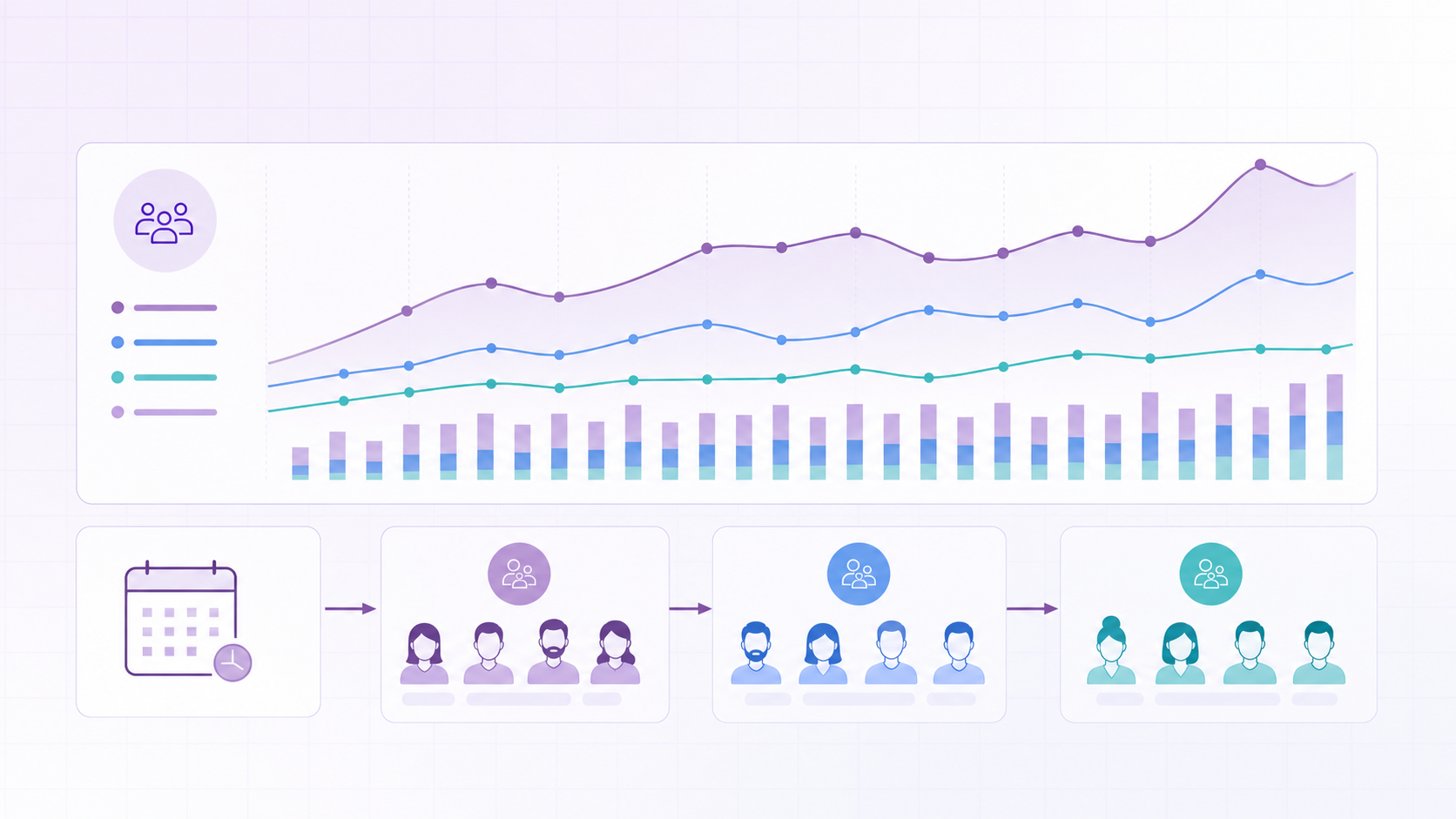
That history is useful because a single open role can be random. A three-month or twelve-month trend is much more meaningful.
- Steady growth can indicate durable expansion.
- Sudden hiring spikes can indicate new initiatives or urgent needs.
- Hiring pauses can indicate uncertainty or shifting priorities.
- Department-level changes can reveal strategy before public announcements.
For investors and researchers, historical hiring data can support market mapping, competitor monitoring, and early growth detection. For sales teams, it can help separate temporary noise from real buying intent.
Hiring data has limits, and history helps you account for them. A posting can stay open after the role is filled, and some companies post roles speculatively to build a candidate pipeline. Seasonal hiring can also create false positives, such as a retailer that adds roles every autumn. Smaller companies may publish few roles, so their data can be sparse. Comparing a company against its own prior quarters and pairing hiring with funding, news, and technology signals reduces this noise.
What to look for in a job postings data provider
If you are comparing job postings data providers, look beyond raw job count. The value comes from structure, freshness, history, and how easily the data fits into your workflow.
- Coverage: How many companies and sources are tracked? Look for coverage in the millions of companies (PredictLeads tracks 3M+).
- Freshness: How often are postings updated? Daily or near-daily refreshes suit most workflows (PredictLeads refreshes job openings approximately every 36 hours).
- Historical depth: Can you analyze hiring trends over time? A year or more of history supports trend analysis, and PredictLeads offers 284.4M+ historical records since 2018.
- Structured fields: Are titles, locations, seniority, categories (such as O*NET occupation codes), and company domains normalized?
- Delivery: Is the data available via API, export, or direct integration?
- Context: Can hiring data be combined with technologies, funding, company news, or similar companies?
To apply these criteria, score providers side by side. Suppose Provider A refreshes daily and keeps 12 months of history, while Provider B refreshes weekly and keeps no history. Provider A is more useful for trend analysis because you can chart hiring velocity by month and catch a spike within a day or two, while Provider B gives you a current snapshot with no baseline to compare against. For a broader vendor comparison, see Top 5 Job Data Providers in 2026.
How PredictLeads uses job postings data
PredictLeads tracks company changes across hiring activity, technologies, company news, funding events, key customers, and similar companies. The Job Openings dataset is designed for teams that need structured hiring signals inside sales, GTM, research, and investment workflows.
- Use it to identify companies with active hiring momentum.
- Combine it with technology signals to understand which internal priorities are taking shape.
- Track historical hiring patterns for market intelligence.
- Feed hiring signals into lead scoring, enrichment, and account prioritization workflows.
Learn more about how hiring data connects to growth analysis in Job Openings Data as a Growth Indicator.
FAQ
Is job postings data alternative data?
Yes. Job postings data is commonly used as alternative data because it provides external signals about company activity, growth, investment priorities, and internal change.
What can job postings data reveal about a company?
It can reveal which teams are growing, where the company is expanding, what capabilities it is investing in, and whether its priorities are changing over time.
How is job postings data used in sales?
Sales teams use hiring activity to rank accounts, personalize outreach, identify expansion signals, and time conversations around current business needs.
Why is historical hiring data useful?
Historical hiring data helps teams see whether a company’s hiring is accelerating, slowing, or shifting between departments. This makes it easier to distinguish real trends from one-off job posts.
What is the difference between job postings data and labor market data?
Labor market data, such as the Job Openings and Labor Turnover Survey (JOLTS) from the U.S. Bureau of Labor Statistics, often focuses on broad employment trends. Job postings data can be used at the company level to understand specific hiring activity, team growth, and account-level intent.
What are the best data sources for account-based marketing (ABM) signals?
Most ABM teams combine three kinds of signals: first-party signals (website engagement, CRM activity, product usage), third-party intent signals, and external company-change signals such as hiring, technology adoption, funding, and news. Job postings data is one of the strongest external signals because an open role usually reflects an approved budget and a named priority. You can score accounts by hiring volume, role mix, and location, then pair that with Technology Detections (evidence of which tools a company uses), Financing Events, and News Events to time outreach. PredictLeads delivers these datasets through API, flat files, webhooks, and Model Context Protocol (MCP). It does not include contact data or review-site intent, so pair it with a contact provider for those gaps.
How do you enrich a CRM with job postings, firmographic, and technographic data via API?
Use the company domain as the match key, then call one endpoint per dataset and write the results to custom CRM fields. With the PredictLeads API, you can pull firmographics from GET /companies/{domain}, hiring activity from GET /companies/{domain}/job_openings (use active_only to return current roles), and technology evidence from GET /companies/{domain}/technology_detections. Store fields such as open role count, top hiring categories, last seen date, and detected technologies. To keep records current, follow companies and receive webhooks when a new job opening or technology detection appears. If you prefer no-code, the native Clay, Make, and n8n integrations expose the same datasets. See the PredictLeads API docs for authentication and field references.
Conclusion
Job postings are more than recruitment noise. They are public signals of company intent.
When structured and analyzed over time, job postings data can show where companies are investing, which teams are growing, and when accounts are more likely to be in motion. That makes hiring activity one of the most useful alternative data sources for understanding company growth and buying intent.
Pingback: B2B Lead Gen Timing Signals | PredictLeads September 2026
Pingback: AI Job Openings Data & Sector Shifts | Sept 2026
Pingback: B2B Job Openings Data Guide October 2026 | PredictLeads
Pingback: Top Job Posting Data APIs October 2026 | PredictLeads