
You can tell within a few calls whether a list was built from signals or just pulled from a database. One feels timely, the other feels like noise, and buyers can tell too. We’ll walk through what counts as a real buying signal beyond the usual website-visit intent data, how to monitor things like competitor hiring, and how to turn all of it into a repeatable outbound playbook your team will actually follow.
TLDR:
- Signal-based selling times outreach to real changes like hiring, funding, or tech swaps.
- Stacking several signals gives a stronger read than acting on one alone.
- A Gartner survey found 73% of B2B buyers avoid suppliers sending irrelevant outreach.
- Detect, rank, personalize, and execute within a defined window to avoid stale outreach.
- PredictLeads sorts detected signals into 12 categories and 47 subcategories across API, flat files, webhooks, and Model Context Protocol (MCP).
What Is Signal-Based Selling
Signal-based selling is a sales approach where outreach starts because something changed, not because a name appeared on a list. The trigger might be a company hiring for a new role, closing a funding round, adopting a new tool, losing a leadership team member, or rewriting a page on its website. Instead of guessing who might be ready to buy, you watch for evidence that something inside the account is already in motion.
The core premise: timing beats volume. A cold list treats every account the same regardless of what is happening inside it. Signal-based selling sorts accounts by what just changed, landing outreach closer to a real moment of need.
Most people hear “signal” and think of website visits or search activity, the behavior tracked by intent data vendors. That is one slice. A signal can be anything detectable in a company’s public footprint: a hiring surge in one department, a new executive hire, a technology swapped for a competitor’s, a financing round, or a new partnerships page. This is why signal-based selling sits inside the broader category of sales trigger events instead of standing apart from it.
Signal-Based Selling vs. Traditional Prospecting and Intent Data
Static-list prospecting treats every account the same way: same cadence, same script, regardless of what is happening inside that account. Signal-based selling reorders outreach around what just changed.
Intent data gets grouped into this conversation, but it covers a narrower slice: search behavior and content engagement. It misses a hiring surge, a new executive, or a technology swap buried in a job posting. Signal-based selling treats intent data as one input among several.
Timing matters more than volume. A Gartner survey found that 61% of B2B buyers prefer a rep-free buying experience, and 73% actively avoid suppliers sending irrelevant outreach. Blind volume plays into exactly the behavior buyers reject.
The Core Types of Buying Signals
- Growth signals: Hiring surges, new offices, or expanding facilities. A company posting 10 new sales roles in a month is likely building capacity ahead of a market push.
- Financial signals: Funding rounds, revenue disclosures, and valuation changes. A Series B close often means fresh budget and a buying window that was not there a month earlier.
- Technology signals: A company adopting a new tool or no longer showing signs of an old one. A target swapping data warehouses or piloting a competitor’s product may be reassessing its stack.
- Organizational signals: Leadership hires, departures, and promotions. A new VP of Marketing often triggers new vendor evaluations within the first 90 days.
- Market signals: Product launches, partnerships, and news coverage, signaling direction instead of routine activity.
Stacking signals, like a hiring surge paired with recent funding, gives a stronger read than any single signal alone.
Signal-Based Selling and Account-Based Marketing
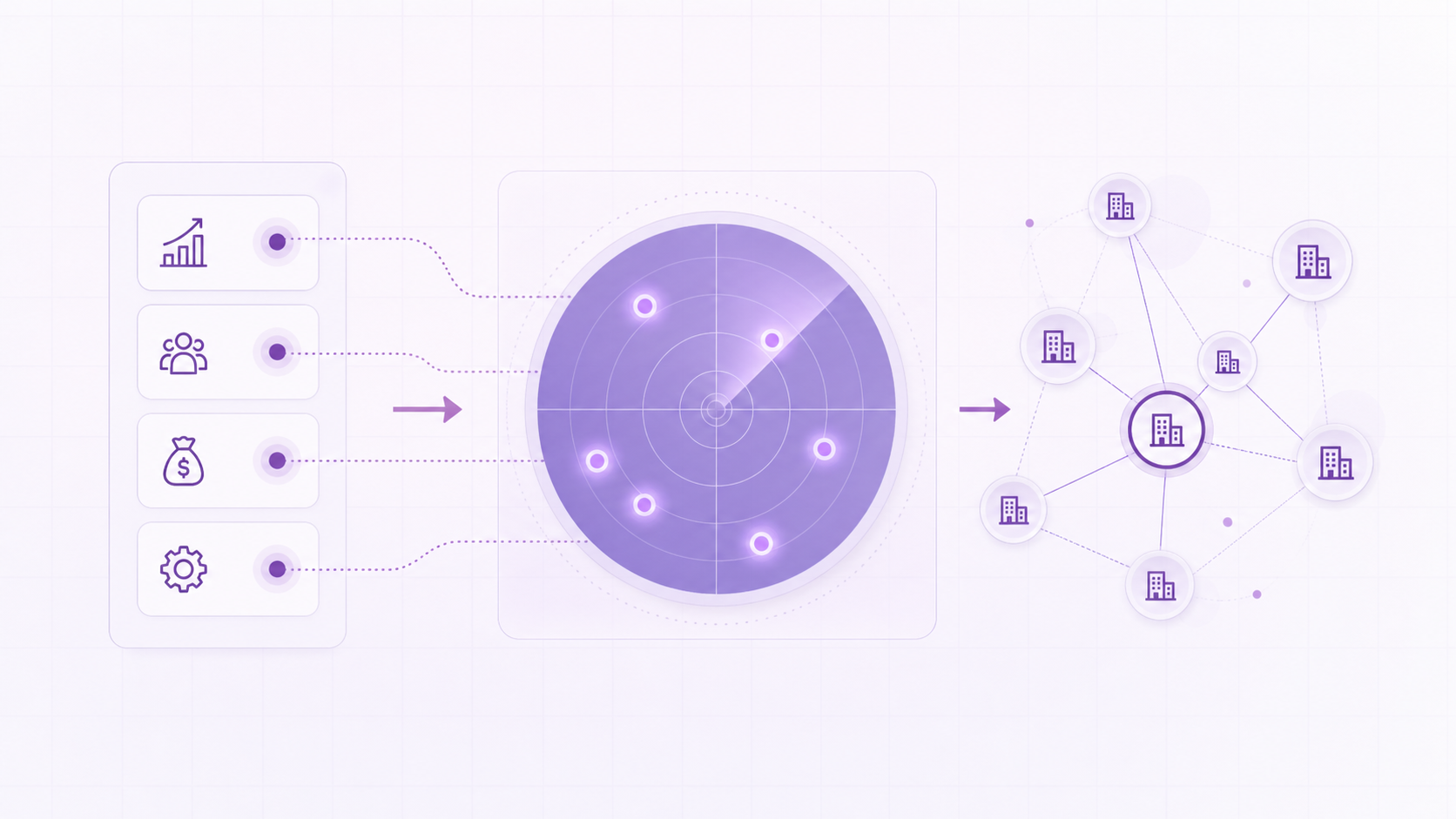
Signal-based selling and account-based marketing pull from the same well: both start by identifying in-market accounts and buying groups, then split on what happens next. ABM turns signals into marketing orchestration (ads, personalized content, account scoring), while sales turns the same signals into outreach timing, deciding when a rep should call and what to say.
Company signals that power B2B lead generation sit at the center of this overlap. Keyword research, IP-based web identification, and display retargeting feed both motions: a marketer decides which accounts see a campaign, a seller decides which accounts get a call this week.
6sense is a frequent reference point here, described as an AI-based revenue intelligence platform built around intent signals and predictive account scoring on 6sense’s platform overview page. Sales teams pair 6sense with firmographic signal data such as hiring surges, technology changes, and funding events, tied to outreach timing instead of ad delivery.
How to Monitor Competitor Hiring and Job Postings
Competitor hiring monitoring usually starts with one of four methods: manually checking career pages, watching LinkedIn job listings, pulling from job board aggregators, or querying an API that captures postings as a structured dataset. Manual checks work at a small scale but break down with more accounts. LinkedIn shows applicant counts and seniority but no history once closed. Aggregators centralize postings, but coverage depends on the boards a company uses. An API pulling from career pages, Applicant Tracking System (ATS) feeds, and LinkedIn gives you first_seen_at and last_seen_at timestamps, showing how long a role stayed live.
What the pattern suggests depends on where postings cluster. A hiring surge in sales or engineering suggests investment in that function. Postings tagged to a new city point to geographic expansion, sometimes toward one of the top US tech hiring hubs. A new required tool in a job description can be stronger supporting evidence of a technology switch, especially paired with a Technology Detections change on the same account.
None of this confirms an internal decision. A surge can reflect backfill for attrition, not growth, and a closed listing can mean the role was filled, paused, or never had budget. Detection gaps happen too, from a career page redesign to a posting pulled from one board but left live on another. Treat hiring patterns as evidence worth acting on, not proof of strategy.
To set up a repeatable monitoring process:
- Define the target account list and the functions or seniority levels you want to track, such as sales, engineering, or VP-level roles.
- Connect a job postings feed that pulls from career pages, ATS feeds, and LinkedIn so postings get captured across every channel a company uses.
- Check the first_seen_at and last_seen_at timestamps on each posting to see how long a role has stayed open and when it came down.
- Flag clusters, like five or more open roles in one function within 30 days, instead of reacting to a single posting.
- Cross-reference a flagged cluster against other signals, such as a Technology Detections change or a funding event, before routing it to a rep.
A Framework for Turning Signals Into Action
A repeatable operating model has four stages: detect, rank, personalize, and execute. Skip one, and the motion collapses into guesswork.
- Detect: Capture signals across every source you can reach, including hiring as a buying signal, funding announcements, leadership changes, technology changes, and website updates. A team watching only funding events misses the larger stream of hiring and technology signals.
- Rank: Score accounts by fit and signal strength together. A hiring surge outside your ICP is still noise. Skip this, and reps chase the loudest signal instead of the best one.
- Personalize: Tie the message to the specific signal, referencing the role being hired for or the tool recently adopted, not a generic template with a company name dropped in.
- Execute: Route the account to the right rep inside a defined window. A signal acted on weeks later has lost most of its value.
Build a Signal-Based Selling Playbook
A playbook turns the detect, rank, personalize, execute framework into something a rep can follow. Start narrow: pick two or three signal types tied to your ICP, since covering 10 signal types on day one usually means none get worked well.
For each signal, define six things before any outreach goes out:
Signal | Trigger | Message angle | Channel | Owner | Timing |
|---|---|---|---|---|---|
Hiring surge | 5+ open roles in target function within 30 days | Reference the specific roles and buildout | Email, then LinkedIn | SDR | Within 48 hours |
Technology swap | Competitor tool no longer detected, new tool detected | Mention the switch and integration angle | AE | Within 3 business days | |
Funding event | Series A or later closed in last 30 days | Reference round size and budget timing | Email, then call | SDR | Within 5 business days |
Write one template per signal, naming the function, headcount, or round size directly, drawing on company signals across hiring, funding, and technology to rank accounts. Assign a single owner so accountability does not blur. Once a signal converts, expand to the next instead of adding types before the first two are tested.
Common Mistakes That Undermine Signal-Based Selling
Four mistakes tend to sink a signal-based selling program before it proves itself.
Treating every signal as equally urgent is the first. A hiring surge and a single job posting carry different weight, but teams without a prioritization step route both to the same rep queue at the same speed.
Acting on one weak signal instead of stacking several is the second. A lone job opening might mean backfill, not growth. Reps burned by false starts stop trusting the data, even when a stronger stacked pattern comes through later.
Ignoring data quality is the third. A technology no longer detected can mean a real switch, a script change, or a recrawl gap, and treating every gap as confirmed churn builds outreach on a guess.
Signal fatigue is the fourth. Piping every signal type into a queue without filtering for ICP fit buries what matters, and reps quietly stop checking the feed.
How to Measure the Impact of Signal-Based Selling
Three metrics tell you whether a signal program is working or just generating noise.
Time to first touch measures how long it takes a rep to act once a signal fires. A hiring surge spotted on Monday and worked on Friday has lost most of its value, since the account has moved on by then. Signal-to-meeting conversion rate shows which signal types produce conversations, separating a funding event that consistently books calls from a job posting that rarely does. Pipeline sourced from signal-triggered outreach, tracked separately from static-list pipeline, makes the case for the program to anyone outside the sales team, which matters when comparing the best B2B data providers for this kind of work.
None of this works without logging the signal type and source on every touch. Without that field, you cannot tell whether your best meetings came from technology swaps or leadership changes.
A rep referencing a specific hiring surge in an email often gets a reply where a generic template does not, and that same specificity tends to carry through to the win rate on accounts that convert. Treat any fixed percentage you see elsewhere as a claim to verify, not a benchmark to promise leadership.
Build the Right Tech Stack for Signal-Based Selling
A signal-based program needs three layers, not one tool claiming to do everything.
- Detection layer: captures raw signals (hiring data, funding events, technology changes, news coverage, website updates). Every downstream layer depends on what gets caught here and how fresh it stays.
- Enrichment and routing layer: attaches signals to the right CRM record (HubSpot, Salesforce) and decides who sees them, tagged with context so a rep can act without digging.
- Execution layer: the sales engagement or email tool that turns a signal into a scheduled message.
Automation tools like Zapier, Make, or n8n often connect these layers. A new job opening can trigger a workflow that creates a CRM task, adds the account to a sequence, and notifies the owner in one pass.
How PredictLeads Supports Signal-Based Selling
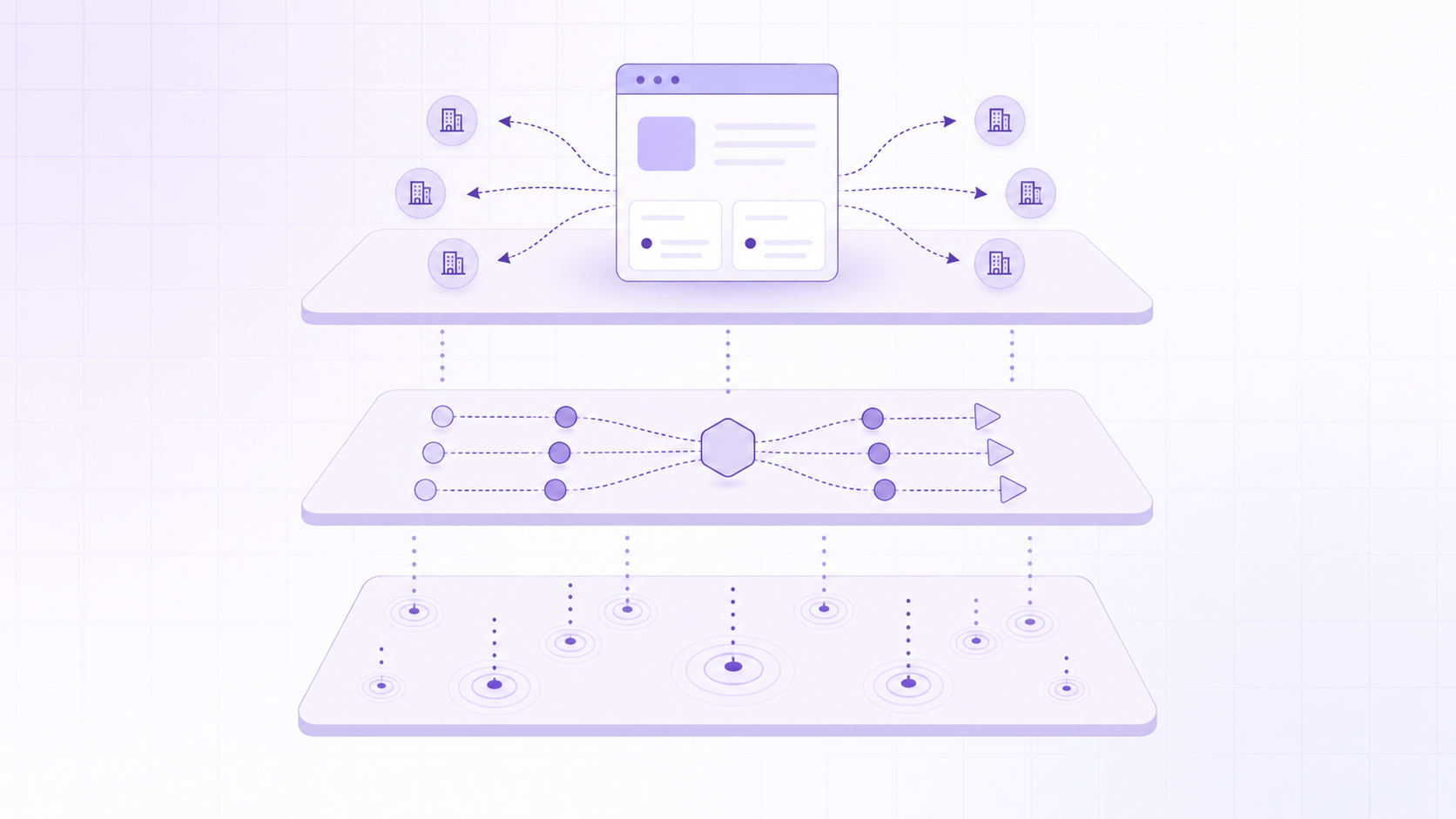
PredictLeads built its Company Signals dataset around the same detect, rank, personalize, execute logic covered earlier. Detection pulls from job descriptions, news coverage, SEC filings data, website changes, and Technology Detections, the same sources a manual signal hunt would check one at a time. Events are deduplicated so one event reported three ways becomes one signal.
Delivery follows the same schema across API, flat files, webhooks, and MCP. A signal reaching a CRM through a webhook looks identical to one an AI agent pulls through MCP.
A signal record might read: category “people,” subcategory “department hiring surge,” headline “Hiring surge in Operations,” noting 11 new Operations openings in 30 days against a usual monthly average of 1.56, carrying both the trigger and the message angle.
Start with $20 in free credits when you create an account, no credit card, no sales call.
Final thoughts on signal based selling strategy
The accounts worth calling are the ones already in motion, not the ones sitting quietly on a static list. Keep your detection sources wide, your prioritization tight, and your messages tied to the actual signal, and the rest tends to follow. Grab $20 in free credits when you create an account and see how it fits your own pipeline, no credit card or sales call needed.
FAQ
What is signal-based selling in B2B sales?
Signal-based selling is an outbound approach where you trigger outreach based on a detected change inside an account, such as a hiring surge, a funding round, or a technology swap, instead of working a static list in the same order every time. The goal is to time outreach to a real moment of need instead of treating every account the same regardless of what is happening inside it.
Is 6sense a signal-based selling tool or an account-based marketing platform?
6sense is positioned as a revenue intelligence platform built around intent signals and predictive account scoring, and it sits mainly on the marketing orchestration side of account-based marketing (ads, content personalization, account scoring). Sales teams running signal-based selling generally pair it with firmographic signal data, such as hiring surges, technology changes, and financing events, since that layer drives outreach timing instead of ad delivery.
How do I find companies that recently switched software vendors?
Look for a technology that is “no longer detected” on a company’s stack paired with a new, competing technology showing a recent first_seen_at date; that pairing is stronger supporting evidence of a switch than either signal alone. PredictLeads’ Technology Detections dataset surfaces this by tracking detections from script tags, DNS records, job descriptions, and more across 98 million-plus company domains, though a missing detection alone can also reflect a script change or recrawl gap instead of confirmed churn.
What’s the best way to get notified when a target account posts a new job opening?
Webhooks are the most direct route: you follow a target company and get pushed a notification the moment a new job opening is detected, instead of checking career pages or LinkedIn on a schedule. PredictLeads delivers this through its Track webhooks on the Job Openings dataset, charging per delivered signal instead of requiring a sales call to set up.
Can signal-based selling replace traditional intent data entirely?
No, intent data still has a role, but it only covers search behavior and content engagement, missing signals like a hiring surge, a leadership change, or a technology swap buried in a job description. A signal-based selling program treats intent data as one input among several instead of the only trigger worth watching.
Ready to see this in your own data?
Start with $20 in free credits when you create an account – no credit card, no sales call.