
Company growth signals help sales, marketing, investment, and data teams identify businesses that are expanding before that growth becomes obvious. They come from hiring activity, funding events, technology adoption, partnerships, product launches, office expansion, and other company-level changes.
Data teams supporting GTM programs should act on hiring activity, funding events, technology adoption, and news-based signals (partnerships, product launches, expansions) first, because they sit closest to budget and capacity and arrive as structured, timestamped records that are fast to score. For GTM teams, the value is timing: a company that is hiring aggressively, entering a new market, or adopting new tools may be more likely to buy, partner, invest, or respond to relevant outreach.
This guide explains which company growth signals matter, how to interpret them, and how to use them in account ranking and sales workflows. It includes a comparison table that ranks five common signals by lead time and priority, examples of signal combinations, and FAQ answers on scoring and false positives.
TLDR:
- Company growth signals – hiring, funding, technology adoption, and news events – show which accounts are expanding before competitors notice.
- Job Openings and Technology Detections rank highest for data teams: both appear early and tie directly to approved budget and tooling change.
- Combining two or more independent signal types in the same window reduces false positives and surfaces accounts with real, current needs.
- Use firmographics to define who belongs on your list, then rank by recent signal activity to decide who gets contacted first.
- PredictLeads provides structured company signals across Job Openings, Financing Events, Technology Detections, and News Events via API, flat files, webhooks, and Model Context Protocol (MCP).
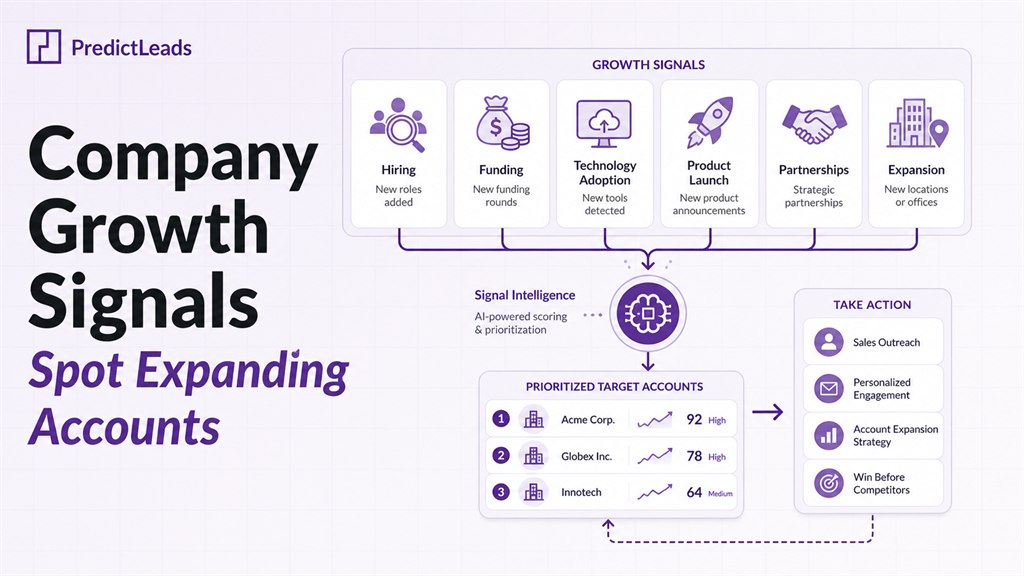
Company growth signals help GTM teams identify expanding accounts by combining hiring, funding, news events, technology adoption, and market activity.
What Are Company Growth Signals?
Definition of growth signals
Company growth signals are observable events or data points that suggest a company is expanding, investing, changing direction, or increasing its capacity to deliver. They help teams move beyond static firmographic data and understand what is happening now.
Common types of growth signals
- new job openings
- funding announcements
- new product launches
- partnerships and customer announcements
- technology adoption
- new locations or market entries
- leadership changes
Why patterns beat single signals
One signal can be useful. A pattern of signals is stronger. For example, a company that raises funding, hires sales leaders, and launches in a new region is showing clearer expansion intent than a company with one isolated job posting.
Consider a hypothetical mid-size SaaS company. In the same month, it records a Series B in Financing Events (receives_financing), posts 15 new sales engineering roles in Job Openings, and shows a new CRM in Technology Detections with a recent first_seen_at. A data team scoring this account might assign points like these (the weights are illustrative, so calibrate them against your own closed-won accounts):
- Series B in the last 30 days: 25 points, because fresh budget usually comes with a mandate to scale.
- A cluster of 15 sales engineering openings: 30 points, because a hiring cluster in one function is stronger evidence of a planned build-out than a single posting.
- A new CRM detection: 20 points, because it is evidence of a recent tooling change, though a mention in a job description alone would count for less.
- A bonus of 15 points for three independent signal types landing in the same window.
In this illustrative example, that account scores 90 out of 100. A company with only a Series B would score 25, and one with a lone sales engineering posting would score closer to 8, so both would stay in a nurture queue. The 90-point account moves to a high-priority queue and routes to the account executive (AE) who owns that segment. In many cases, the first message can reference the build-out directly: a funded company that is staffing pre-sales and standing up a new CRM may need enrichment, integrations, or implementation support within its first few quarters of scaling. Apply a recency decay as well, so the same combination seen six months ago would score lower than it does today.
Why Growth Signals Matter for GTM Teams
Why static data falls short
Most account lists start with static data such as industry, employee count, revenue, and geography. That data helps define fit, but it does not show urgency. Company growth signals add movement and timing.
Consider a hypothetical list of 1,000 mid-size software companies in North America. Sorted by employee count or alphabetically, every account looks equally ready to talk, and a rep has no reason to call one before another. Rank the same list by recent activity and the order changes: a company with a new Series B in Financing Events, a cluster of sales openings in Job Openings, and a recent technology detection moves to the top, while a company with no change in months stays near the bottom. The list is the same, but the signals decide who gets contacted first.
How sales, marketing, and data teams use signals
A sales team can use growth signals to rank accounts that are more likely to have a current business need. A marketing team can use them to build more relevant segments. A data team can use them to enrich scoring models and routing workflows. Timing and relevance carry weight because buyers do much of their research alone: a 2025 Gartner survey of 632 B2B buyers found that 61% prefer an overall rep-free buying experience, and 73% actively avoid suppliers who send irrelevant outreach. These figures come from industry research, not PredictLeads data, and they show why early, specific signals matter: a message tied to something a company is doing now is more likely to read as relevant than a generic pitch.
Here is how each team can apply that in practice. A sales development representative (SDR) who sees a partners_with event in News Events and a new integrations page in Website Evolution for the same account can open with the partnership and ask how the integration affects their roadmap, instead of sending a cold template. A marketer can group accounts that show an opens_new_location event and job openings in the new region into a “expanding into a new market” segment and send that group a regional sequence. A data engineer can write each signal into an account score with a recency decay, so a hiring cluster seen last week counts for more than one seen last quarter, and route the top accounts to the right owner automatically.
Related reading on hiring signals
PredictLeads explains one of the most useful signals in how hiring signals reveal company growth.
The Most Useful Company Growth Signals
Not every growth signal deserves the same weight. Some appear before a company announces anything and point to a funded, staffed need. Others show up in press releases that every vendor in your category reads on the same day. The table below ranks five common signals by how early they tend to appear and how reliably they point to a current business need, so you can decide which ones to score first.
Signal Type | What It Indicates | Typical Lead Time Before Competitors Notice | Priority for Data Teams |
|---|---|---|---|
Hiring activity (Job Openings) | Capacity and budget already approved. A cluster of SDR and AE openings can point to a sales build-out, while data engineering roles can point to analytics or AI work. Seniority, O*NET codes, and job descriptions show the likely priority. | Often early. Many openings appear on career pages before any press coverage, and few vendors monitor them account by account. The window usually lasts as long as the role stays open. | High. It is the earliest signal tied to approved budget, and |
Technology adoption (Technology Detections) | Evidence that a company has started using, or recently stopped using, a tool. A new warehouse, CRM, or marketing automation detection can create demand for integrations, enrichment, and implementation support. | Often early for infrastructure and back-office tools, since script tags, DNS records, and job descriptions can reveal a change before the company mentions it publicly. | High. A recent |
Funding and financing events (Financing Events) | Fresh budget and a mandate to scale. A Series A or Series B round ( | Short. Funding announcements reach investor newsletters and news feeds quickly, so many vendors see them within days. | Medium. It is a reliable budget signal, but the timing advantage fades fast. Pair it with hiring data to find which funded accounts are already staffing up. |
News events (partnerships and product launches) | Strategic direction and market activity. | Short to moderate. Press coverage is public, but a partnership with a niche vendor or a launch in a new region may go unnoticed by teams that do not monitor events by category. | Medium. It gives strong outreach context, but intent varies by event. Filter by category and a minimum |
Leadership changes (News Events) | A possible vendor review. A new VP of Sales or Head of Data ( | Short. Executive moves are posted on LinkedIn and in company announcements, so competitors with contact-based alerts tend to see them quickly. | Low. The link to a purchase is indirect, and the timing of any vendor review varies widely. Use it as a supporting signal alongside hiring or technology changes. |
Here is how the ranking plays out in practice. Take two accounts in the same segment. The first shows a new data warehouse in Technology Detections (High) and a partners_with event in News Events (Medium) in the same month. The second shows only a new VP of Sales in the hires category (Low). The first account has evidence of a tooling change plus a strategic move, so it should rank higher. The second stays a supporting signal until hiring or technology activity corroborates it. Weights depend on your product, so adjust the priority column to match the buyers you sell to, and validate it against your closed-won accounts.
Hiring activity
Actively hiring companies are among the clearest growth indicators because companies usually hire when they need more capacity. New sales roles can signal revenue expansion. Engineering roles can signal product investment. Data roles can signal analytics or AI initiatives.
For practical workflow ideas, see Hiring Signals for B2B Sales.
Funding and financing events
Funding often creates a window for new tools, headcount, vendors, and strategic changes. Teams can use financing events to identify companies with new budget or a mandate to scale.
PredictLeads also covers this in Financing Events for investor research.
Technology adoption
New technologies in a technographics dataset can reveal changes in how a company works. A company adopting a cloud data warehouse, CRM, marketing automation platform, or developer tool may need integrations, enrichment, implementation support, or complementary products.
For related segmentation strategy, read Technographic Segmentation.
News events
Company news events reveal product launches, partnerships, acquisitions, customer wins, geographic expansion, and executive changes. These events give GTM teams timely context for trigger-based outreach and account monitoring.
See PredictLeads News Event Categories for a deeper look at event types.
How to Use Growth Signals in Sales Workflows
Map each signal to a hypothesis
Start by mapping each signal to a business hypothesis. If a company is hiring sales leaders, the likely need may involve pipeline, territories, enrichment, or sales operations. If it is adopting a new data platform, the need may involve analytics, integration, or data quality.
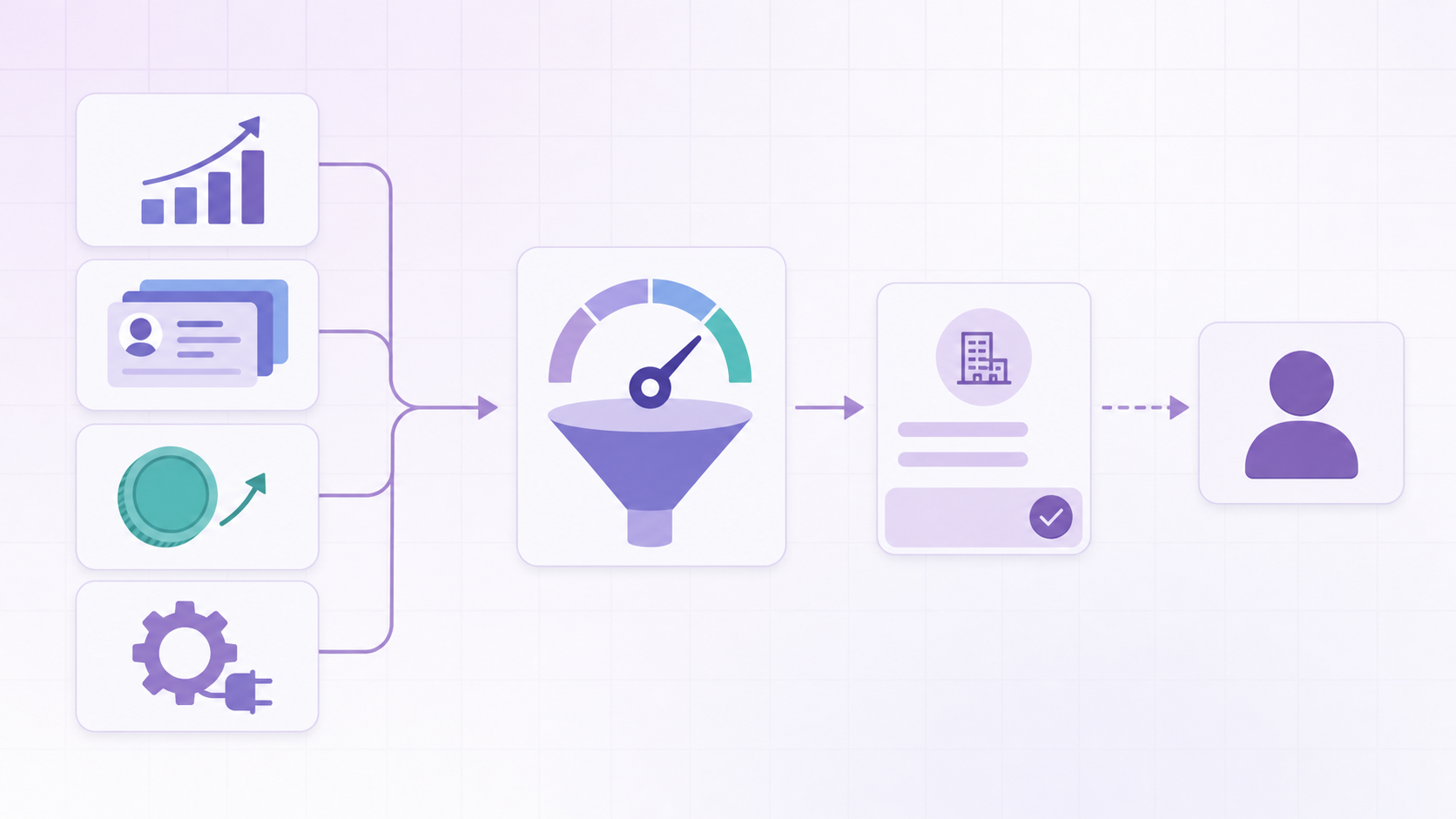
Keep each pairing short and specific. A sales leadership hiring cluster in Job Openings points to pipeline, territory, or enrichment needs, so reference the build-out and offer support for the new team. A new data warehouse, CRM, or marketing automation detection in Technology Detections points to integration and data quality gaps, so mention the recent tooling change. A Series A or Series B round in Financing Events points to new budget, so tie the message to scaling plans and pair it with hiring data to confirm where the money is going. A partnership or product launch in News Events points to demand for supporting tools, so cite the announcement. Treat a new VP of Sales or Head of Data as a supporting signal alongside hiring or technology changes.
Five steps to apply growth signals
- Define the signals that matter for your product.
- Score accounts based on signal strength and recency.
- Combine signals with ICP fit.
- Route high-priority accounts to sales or marketing.
- Personalize outreach around the likely business priority.
Static firmographic targeting vs. signal-based prioritization
Before you rebuild your scoring model, compare the two approaches most teams choose between. Static firmographic-only targeting filters accounts by industry, size, revenue, and location, then works the list in a fixed order. Signal-based prioritization keeps those filters but ranks accounts by recent activity such as hiring, financing, technology changes, and news events. The table below covers the trade-offs data teams weigh most often.
Approach | Pros | Cons |
|---|---|---|
Static firmographic-only targeting | Simple to build. A few filters (employee range, NAICS code, location) produce a list in one query, and a data team can maintain it with little engineering time. Stable and predictable. Attributes such as industry and country change slowly, so the list does not swing from week to week and territory planning stays straightforward. Low noise on fit. Every account matches your ICP definition, so you rarely chase a company that is clearly outside your market. | No timing information. A list of 5,000 matching accounts treats a company that just raised funding the same as one that has not changed in years, so reps often start with the wrong accounts. Slow to reflect change. A company that grows from 80 to 400 employees can sit in the wrong segment until the next list refresh, and a company that cuts headcount can stay on a priority list. Generic outreach. With no recent event to reference, messages default to broad templates, which buyers tend to ignore. |
Signal-based prioritization | Fresh data. Records carry Responds to market changes. New openings, funding rounds, and technology detections move an account up the queue within days, and a hiring freeze or a closed role moves it down. Better outreach context. A message that cites a specific event, such as a new sales team or a recent warehouse detection, is more likely to read as relevant than a generic pitch. | False positives from single signals. One unrelated job posting, a low-confidence news event, or a technology mentioned only in a job description can inflate a score. Require a second, independent signal type before routing. Higher implementation complexity. Data teams have to choose signal types, set weights, apply recency decay, deduplicate events, and map records to your CRM account IDs. Ongoing calibration. Weights drift as markets change, so you need to backtest against closed-won accounts and review them regularly. Webhook volume also needs filters, because delivery is billed per signal. |
Here is how the difference plays out. Suppose a firmographic filter returns 2,000 US SaaS companies with 200 to 500 employees. Worked in alphabetical or revenue order, the list gives a rep no reason to call one account before another. Add signals and the same list changes: 40 of those companies posted five or more sales roles in Job Openings during the last 30 days, and 12 of those also show a recent receives_financing event. Those 12 accounts go to the top of the queue, and the rest stay in a nurture sequence. The firmographic filter still defines who belongs on the list. The signals decide who gets contacted first.
For most teams, the practical answer is to combine both. Use firmographics as a gate for fit, then use signals to rank within that gate. Start with two or three signal types you can validate, such as hiring clusters and financing, and add Technology Detections and News Events once the scoring model has proven itself against your own conversion data. If your team has limited engineering time, a firmographic-only list is a reasonable first version, as long as you plan to add timing signals before the list goes stale.
Combine multiple signals
The strongest workflows combine multiple signals. Hiring plus funding plus relevant technology adoption usually tells a better story than any single signal alone.
Set the routing threshold so that no single signal can clear it. Take a hypothetical data infrastructure vendor that sets a threshold of 60 points over a 30-day window (the weights below are illustrative, so calibrate them against your own closed-won accounts). Three accounts show different patterns:
- Account A has a Series A in Financing Events (
receives_financing) and nothing else: 20 points. It stays in a nurture queue. - Account B has six data engineering openings in Job Openings and nothing else: 25 points. It also stays in nurture, since the openings could be routine backfills.
- Account C has a
receives_financingevent (20 points), five data engineering openings (25 points), and a cloud data warehouse detection with a recentfirst_seen_at(20 points), plus a 15-point bonus for three independent signal types in the same window. It scores 80 and routes to the account owner.
Account C clears the threshold because each signal covers a gap in the others. The funding event shows budget, the openings show where the team is growing, and the warehouse detection is evidence of a tooling change that may need integrations and implementation support. The first message can reference all three: a funded company that is staffing data roles while setting up a new warehouse.
Frequently Asked Questions
Which business signals should data teams act on first?
Start with the signals closest to budget and capacity: Job Openings, Financing Events (receives_financing), and News Events in categories such as increases_headcount_by, opens_new_location, and expands_offices_to. Then add Technology Detections and Connections as fit and context signals. Pick the first signals by mapping them to your product. A sales tooling vendor may weight SDR and AE job openings, while a data infrastructure vendor may weight data engineering roles and new warehouse detections.
How do data teams combine multiple growth signals into a single score?
Assign each signal type a weight, apply a recency decay, and sum the results. Add a bonus when two or more independent signal types appear in the same window, for example a funding event plus a cluster of new sales job openings. Keep ICP fit as a separate score or a gate so you can see whether an account ranks high because of timing, fit, or both. Calibrate the weights against your closed-won accounts, and adjust them as you learn which signals precede real pipeline.
What is the difference between intent data and company growth signals?
Intent data usually captures research behavior, such as content consumption or topic searches that suggest a buyer is looking at a category. Company growth signals are observable company-level changes from public sources, such as hiring, financing, news events, and technology adoption. Intent suggests someone is researching a topic, while growth signals suggest a company has the capacity or reason to change. Many teams use growth signals to select accounts and intent data to refine timing.
How recent should a signal be to be considered actionable?
It depends on the signal type, so set separate windows for each and test them against your own conversion data. A news event such as a funding round tends to lose its edge quickly as other vendors also reach out, while a job opening stays relevant as long as the role remains open. Use first_seen_at to measure how new a signal is and last_seen_at to confirm it still appears. In many cases, a technology detection with a recent first_seen_at is stronger evidence of change than one that has been present for years.
How do data teams avoid false positives from a single signal?
Require corroboration from a second, independent signal type before an account moves into a high-priority queue. Filter job openings by category, seniority, and O*NET code so a single unrelated posting does not count. Set a minimum confidence value on News Events, and check the source URL on borderline cases. Treat a technology mentioned in a job description as supporting evidence of use or planned adoption, not confirmation of an active installation.
What tools or data sources do data teams use to track these signals?
Data teams pull signals from the PredictLeads API for company-level lookups and for searches across the full dataset by signal type, and from webhooks that push new signals for followed companies. For bulk analysis, flat files load into a warehouse such as Snowflake or BigQuery, and MCP gives AI agents direct access to the same datasets. No-code teams connect the data through Clay, Make, or n8n and route scored accounts into the CRM. Internal sources such as CRM history and product usage complete the picture and help calibrate the scoring model.
Can you track growth signals for private companies?
Yes, because these signals come from public sources such as career pages, company websites, and news coverage, so you do not need financial filings. A private company that adds a pricing page, posts a cluster of engineering roles, and announces a Series B in the same quarter shows expansion through Website Evolution, Job Openings, and Financing Events alone.
How many signals should an account show before you reach out?
There is no fixed number, but many teams start with two independent signal types in the same window, such as a new Technology Detection plus a set of relevant job openings. Test the threshold against your closed-won accounts and raise or lower it based on how many flagged accounts turn into real conversations.
How do investors use growth signals differently from sales teams?
Sales teams read signals as buying windows, while investors read them as momentum indicators for companies that publish little financial data. Hiring velocity, Website Evolution (new product, customer, and integrations pages), and GitHub Repositories activity can point to a breakout company before a round is announced.
How do you get alerted when a target account shows a new growth signal?
Follow the company and use webhooks, which push a notification when a new job opening, technology detection, news event, or connection appears for it. Route the event into your CRM or a tool such as Clay, Make, or n8n so the account owner sees the signal while it is still fresh.
Final Thoughts
What growth signals change
Company growth signals help teams identify accounts that are changing now. They make prospecting, segmentation, scoring, and outreach more timely and relevant.
Data teams should start with four signal types: hiring activity in Job Openings, funding in Financing Events (receives_financing), technology adoption in Technology Detections, and News Events such as partners_with, launches, and opens_new_location. Hiring and funding sit closest to approved budget and capacity. Technology adoption is evidence of a tooling change that can create demand for integrations, enrichment, and implementation support. News events add the context that makes a first message specific.
Combining these signals outperforms any single one because each has a different blind spot. A funding round shows budget but not where it will go. A job posting can be a routine backfill. A technology mentioned in a job description may reflect client work or a hiring requirement instead of active use. A news event can carry a low confidence value. When two or more independent signal types land in the same window, such as a Series B, a cluster of sales openings, and a new CRM detection, the account is more likely to have a real, current need and less likely to be a false positive.
Your next step is to start small. Pick one or two high-confidence signals, for example a hiring cluster in a function that maps to your product and Financing Events from the last 90 days, and score accounts against them. Backtest that score against your closed-won accounts, then layer in Technology Detections and News Events (filtered by category and minimum confidence) as the model matures. Add recency decay and a corroboration bonus last, once you can see which signals precede real pipeline.
Access structured company signals
PredictLeads helps teams access structured company signals across hiring, news events, technologies, financing events, and more, so GTM and data teams can act before opportunities become obvious to everyone else.
Ready to see this in your own data?
Start with $20 in free credits when you create an account – no credit card, no sales call.
Pingback: B2B Lead Gen Timing Signals | PredictLeads August 2026
Pingback: Tech Co. Lead Gen: Stack Signals | September 2026
Pingback: Lead Scoring Model: Company Growth Signals Sep 2026