
NVIDIA hiring trends offer a useful example of how job openings data can reveal company strategy before it appears in earnings calls, product announcements, or analyst reports. By looking at the roles a company is hiring for, teams can understand where it may be investing next.
For NVIDIA, hiring activity around AI engineering, GPU systems, data center infrastructure, healthcare AI, automotive, and global engineering hubs points to broader market demand for AI infrastructure and specialized technical talent.
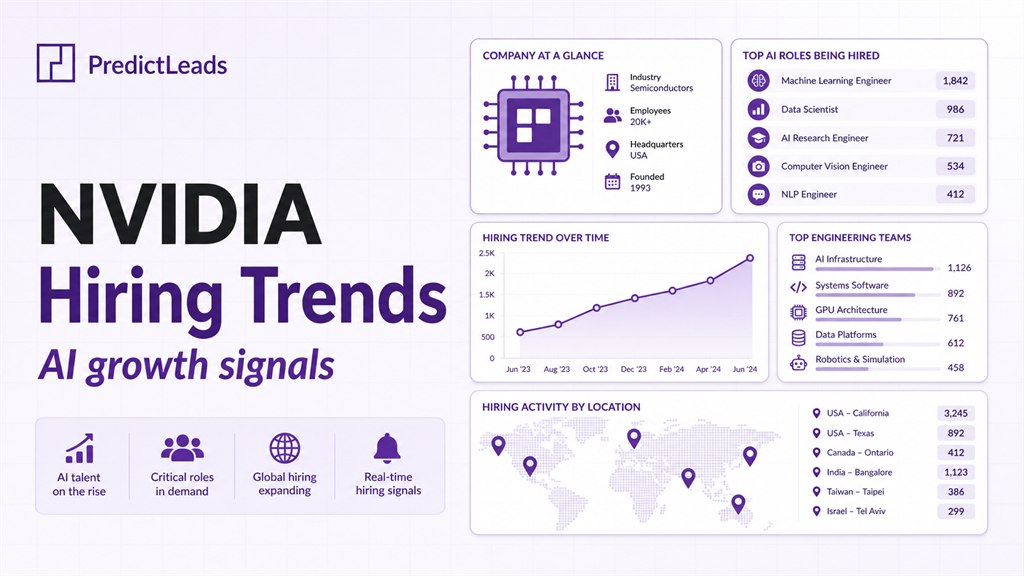
Hiring trends can reveal how NVIDIA and other AI companies are investing in engineering, infrastructure, and future growth.
TL;DR
- NVIDIA job postings point to continued investment in AI engineering, CUDA/GPU systems, and data center infrastructure.
- NVIDIA reported approximately 36,000 employees at the end of fiscal 2025 per its 10-K, but newer standardized headcount figures vary by source.
- GTM-specific hiring (sales, marketing, customer success) and vendor adoption are harder to confirm publicly than engineering hiring.
- You can track any company’s hiring with the PredictLeads Job Openings dataset via API, flat files, webhooks, or MCP.
Quick Answer: What NVIDIA Hiring Trends Reveal
NVIDIA hiring trends suggest continued investment in AI infrastructure, deep learning, GPU systems, data center optimization, and industry-specific AI applications. Job postings can reveal which skills, locations, and product areas are becoming priorities long before those priorities become visible through traditional company news.
Related guides: job openings data and company growth, job openings data for sales prospecting, and AI adoption trends in job openings data.
The table below brings together publicly reported figures and PredictLeads Job Openings data to show the kinds of signals that, taken together, point to NVIDIA’s hiring and growth direction.
Signal Type | Evidence/Example | Date | Source |
|---|---|---|---|
Headcount Growth | Approximately 36,000 employees at end of fiscal 2025 | Fiscal year ended January 26, 2025 | NVIDIA fiscal 2025 Form 10-K |
Revenue Context | Fiscal 2026 revenue of $215.9 billion, up 65% year over year | February 2026 | |
AI and Data Center Engineering Hiring | Postings for deep learning, CUDA, GPU systems, and infrastructure roles | 2025 to 2026 | PredictLeads Job Openings data for nvidia.com |
Sales Hiring | Evidence limited/not publicly confirmed | Evidence limited/not publicly confirmed | Evidence limited/not publicly confirmed |
Marketing Hiring | Evidence limited/not publicly confirmed | Evidence limited/not publicly confirmed | Evidence limited/not publicly confirmed |
Customer Success Hiring | Evidence limited/not publicly confirmed | Evidence limited/not publicly confirmed | Evidence limited/not publicly confirmed |
Technology Adoption | Evidence limited/not publicly confirmed | Evidence limited/not publicly confirmed | Evidence limited/not publicly confirmed |
1. AI Engineering Talent Is a Core Signal
NVIDIA job postings often show demand for AI and deep learning talent. Roles such as deep learning engineers, AI solutions architects, GPU computing specialists, and infrastructure engineers can show where the company is expanding technical capacity.
Common skill signals include:
- PyTorch and TensorFlow
- CUDA and GPU programming
- LLM training and inference optimization
- distributed systems and high-performance computing
These roles matter because they reflect more than general hiring. They point to the technical capabilities NVIDIA needs to support AI workloads at scale.
Technology and Vendor Adoption Signals
Job descriptions can name specific tools such as CUDA, PyTorch, Kubernetes, and various MLOps tooling. When you see these terms in a posting, it can point to current usage, planned adoption, client work, or a skill requirement for the role. It does not confirm that NVIDIA has installed or is running a given tool across its stack.
The public sources used for this analysis do not confirm a specific list of newly adopted vendors, cloud platforms, or CRM and GTM software at NVIDIA over the last 12 to 18 months. On its own, this makes vendor adoption a weak signal when you rely on public job postings alone.
You can pull a company’s Technology Detections from the PredictLeads API. This dataset provides evidence of which technologies a company uses or has recently used, drawn from script tags, DNS records, and job descriptions. When you combine it with job-posting changes, you get stronger supporting evidence of a possible transition, though still not confirmation of what a company has installed.
2. Data Center and Infrastructure Roles Show AI Demand
Hiring for data center, cloud infrastructure, networking, and systems engineering roles can indicate where AI infrastructure demand is growing. For a company like NVIDIA, these roles are especially important because AI adoption depends on hardware, software, networking, and deployment expertise working together.
When hiring increases across infrastructure-related teams, it can signal product scaling, customer demand, or expansion of enterprise AI workloads.
3. Global Hiring Hubs Reveal Expansion Priorities
NVIDIA hiring activity across the United States, India, Israel, and other technical hubs can reveal how the company distributes engineering and customer-facing work globally.
- United States: AI, product, infrastructure, and high-value engineering roles.
- India: software engineering, system design, and data center optimization.
- Israel: networking, systems, and hardware-software integration.
Location patterns matter because they show where companies are building specialized teams and where regional expertise is becoming strategically important.
4. Healthcare and Automotive Roles Point to Industry-Specific AI
Some NVIDIA job postings point to industry-specific AI applications. Healthcare roles can indicate investment in AI-driven diagnostics, imaging, life sciences, or clinical workflows. Automotive roles can point to autonomous driving, simulation, embedded systems, and partnerships with automotive manufacturers.
These patterns show how hiring data can reveal internal growth as well as the industries a company is betting on.
5. Cross-Functional Roles Show Commercialization
Hiring for solutions architects, customer program managers, partner roles, and technical account roles can indicate that a company is building technology and also helping customers adopt it.
For NVIDIA, these roles are important because AI infrastructure often requires deep technical implementation support. Cross-functional hiring can signal that demand is moving from experimentation into production deployment.
GTM Hiring Signals: Sales, Marketing, and Customer Success
GTM hiring is the next layer to watch. At NVIDIA, titles such as Director of Sales, Enterprise Account Executive, Customer Success Manager, Product Marketing Manager, and VP of Revenue Operations would point to a larger go-to-market motion around enterprise AI accounts and partner programs. Sales leadership and revenue leadership hires in particular tend to show where a company expects new deal volume.
The evidence here is weaker than for engineering. Dated, NVIDIA-specific postings for sales leadership, marketing, customer success, and revenue leadership roles are not publicly confirmed in the sources used for this analysis, so treat GTM hiring as a known gap. The US sales hiring index tracks general sales hiring across the market, not NVIDIA-specific data, so use it as context only.
To verify, filter NVIDIA’s Job Openings by the sales, marketing, and support categories, then narrow by seniority (director, vice_president) and first_seen_at dates. You get a dated list of GTM roles you can compare against engineering hiring over the same window.
Why Job Data Matters for Company Research
Job data is useful because it captures company behavior. Companies hire when they need capacity, skills, and execution. This makes hiring activity a strong signal for company growth, product focus, market expansion, and buying intent.
Headcount numbers add another layer to this picture. NVIDIA’s fiscal 2025 Form 10-K reported approximately 36,000 employees as of the end of fiscal 2025 (January 26, 2025). For the most recent year, you can check the human capital section of the fiscal 2026 Form 10-K (fiscal year ended January 25, 2026). Precise trailing 12-month percentage growth and new-hire counts are not publicly confirmed in a standardized way: third-party trackers count LinkedIn profiles, while filings report company totals, so treat this gap as a limit on any single data source. You can cross-check a LinkedIn headcount tracker or Unify GTM, then layer PredictLeads Job Openings data on top to see which roles and locations drive the growth.
For market intelligence teams, investors, and GTM teams, NVIDIA is a good example of how hiring data can help answer questions such as:
- Which technical skills are becoming more important?
- Which teams or locations are expanding?
- Which industries are receiving more investment?
- Which signals suggest future product or infrastructure priorities?
How to Analyze Company Hiring Trends with PredictLeads
PredictLeads tracks job openings across companies and returns structured hiring data through APIs and datasets. You can use it to analyze a single company, monitor competitors, identify hiring spikes, find companies hiring for specific roles, treat hiring as a buying signal, and compare against typical open roles by company size.
https://predictleads.com/api/v3/companies/nvidia.com/job_openings
From there, teams can analyze job titles, descriptions, locations, categories, seniority, technologies mentioned, first seen dates, and active status.
Frequently Asked Questions
Is NVIDIA growing or shrinking its headcount?
NVIDIA reported approximately 36,000 employees at the end of fiscal year 2025 in its 10-K filing. Newer standardized headcount figures vary by source, so you should treat more recent numbers as unconfirmed until you check a primary filing or company disclosure. If you need a current count, compare multiple sources before you rely on a single figure.
What GTM roles is NVIDIA hiring for?
Postings for solutions architects and partner roles are visible in job openings data, which points to a focus on helping customers implement AI infrastructure. Dated postings for sales, marketing, and customer success roles are not publicly confirmed at this time. You can monitor job openings data directly to see which GTM roles appear as they are posted.
What new technologies or vendors has NVIDIA adopted recently?
Specific technology or vendor adoptions by NVIDIA are not publicly confirmed here. Technology Detections can provide evidence of which technologies a company uses or has recently used, so you can treat a detection as a signal of possible usage, migration, or hiring requirements rather than confirmation of an active installation.
How can I track NVIDIA’s hiring trends over time?
You can query the /companies/nvidia.com/job_openings endpoint and use the first_seen_at and last_seen_at fields to build a timeline of posting activity. You can also follow the company to receive Job Openings webhooks when new postings appear or existing ones close.
How do I find startups hiring engineers as a proxy for product development?
You can use the /discover/job_openings endpoint with O*NET codes such as 15-1252.00 for software developers, combined with location and found_at_from filters, to surface companies actively hiring engineers. Pairing this with Financing Events can help you see which funded companies are also expanding engineering capacity.
How do I build a lead scoring model from company growth signals?
You can score posting velocity across 30, 60, and 90 day windows, then factor in category mix and seniority of open roles. Adding News Events and Financing Events gives you timing context, so you can weigh hiring signals alongside funding and company news when you build the model.
NVIDIA hiring trends show how job openings data can reveal more than open roles. It can uncover growth signals, AI infrastructure demand, global expansion, skill priorities, and commercialization momentum.
For teams that need earlier market signals, hiring data provides a practical way to understand what companies are doing before those moves become obvious elsewhere.
The strength of this evidence varies by category. Headcount growth has public support from NVIDIA’s own filings, and general engineering and AI infrastructure hiring is well supported by visible job postings across multiple sources. GTM-specific hiring, including dated sales, marketing, customer success, and revenue leadership postings, is harder to verify publicly, and the same applies to vendor or technology adoption signals drawn from job descriptions. For deeper verification of these harder-to-confirm categories, structured sources such as PredictLeads Job Openings and Technology Detections can provide more granular, dated evidence than public news alone.
Ready to see this in your own data?
Start with $20 in free credits when you create an account – no credit card, no sales call.