
PredictLeads is now available through Orthogonal, meaning AI agents can query company intelligence signals, hiring, funding, tech, and news, without custom integrations or separate API keys.
This integration allows AI agents to access structured company intelligence signals from PredictLeads without building custom integrations or managing multiple API keys.
Developers can now retrieve company signals such as:
- Hiring activity
- Technology adoption
- Company news events
- Funding activity
- Business connections
These signals can be used inside automated workflows for sales research, investment analysis, competitive monitoring, and market discovery.
TLDR:
- AI agents can query Job Openings, Financing Events, News Events, Technology Detections, and Connections without managing separate API keys.
- Combining four signals in one agent run moves you from a weak buying hint to a confident account priority.
- Sales teams can flag every CRM account that raised a round in the last 90 days and posted sales roles, delivered daily.
- PredictLeads returns normalized JSON across all endpoints, so your agent gets consistent schemas it can act on immediately.
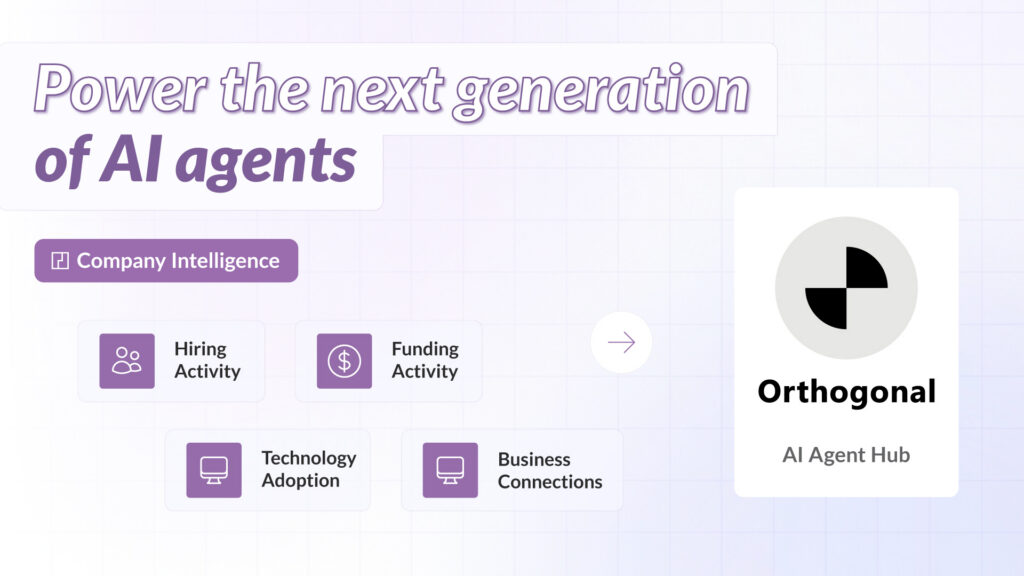
PredictLeads datasets including hiring activity, funding events, technology adoption, and business connections are available to AI agents through the Orthogonal AI Agent Hub.
What Orthogonal Provides
Orthogonal is an API layer designed for AI agents.
Instead of integrating multiple APIs individually, developers connect once to Orthogonal and gain access to a catalog of verified APIs.
Agents can:
- Search for APIs using natural language
- Retrieve endpoint documentation
- Generate integration code
- Execute API calls directly
When you build an AI agent that needs data from multiple providers, each new source adds real friction. You have to read a new set of docs, handle a separate auth flow, manage another API key, and write parser logic for a schema that differs from every other source you already support. Multiply that across five or ten data providers and the integration overhead starts to outweigh the actual agent logic.
Orthogonal’s catalog model removes that friction. Instead of knowing an API by name before you can use it, your agent can describe what it needs in plain terms, for example, “find recent hiring activity for this company,” and Orthogonal matches that intent to the right endpoint in its catalog. The agent finds available tools by capability instead of by hunting through a list of provider names.
PredictLeads fits this model well because each endpoint returns normalized, typed JSON records. There is no raw HTML to parse, no unstructured text to clean, and no inconsistent field names to map. When your agent calls the Job Openings or Financing Events endpoint, it gets back structured data it can act on immediately.
PredictLeads is now part of this ecosystem, allowing agents to retrieve company intelligence data through the Orthogonal interface.
PredictLeads Datasets Available Through Orthogonal
The integration provides access to several PredictLeads datasets that track company activity. The table below summarizes each one at a glance.
Dataset | Endpoint | What It Tracks | Best Used For |
|---|---|---|---|
Job Openings | /v3/companies/{domain}/job_openings | Active and historical hiring activity by role, location, and seniority | Identifying expanding companies, hiring intent signals, sales trigger outreach |
News Events | /v3/companies/{domain}/news_events | Structured company announcements across 37 categories (launches, partnerships, expansions) | Trigger-based selling, competitive monitoring, real-time account alerts |
Technology Detections | /v3/companies/{domain}/technology_detections | Technologies detected via script tags, DNS records, job descriptions, and more | Competitor displacement, integration targeting, tech-stack fit scoring |
Financing Events | /v3/companies/{domain}/financing_events | Funding rounds, investment types, and amounts since 2016 | Outreach timing after fresh capital, deal sourcing, portfolio monitoring |
Connections | /v3/companies/{domain}/connections | Relationships between companies, such as partners, vendors, investors, and integrations | Ecosystem mapping, warm outreach angles, supply chain analysis |
Job Openings Dataset
Endpoint:
/v3/companies/{domain}/job_openings
This dataset tracks hiring activity across companies.
Signals include:
- New engineering roles
- Sales hiring expansion
- Hiring in new regions
- Growth in open positions
Hiring data often indicates company expansion or new initiatives.
News Events Dataset
Endpoint:
/v3/companies/{domain}/news_events
This dataset tracks structured company announcements such as:
- Product launches
- Partnerships
- Market expansions
- Acquisitions
News events provide real-time insight into company strategy and activity.
Technology Detections Dataset
Endpoint:
/v3/companies/{domain}/technology_detections
This dataset identifies technologies used by companies.
Examples include:
- cloud infrastructure
- marketing automation tools
- analytics platforms
- developer tools
Technology adoption signals help understand a company’s technical environment and vendor stack.
Financing Events Dataset
Endpoint:
/v3/companies/{domain}/financing_events
This dataset tracks company funding activity including:
- Seed rounds
- Venture funding
- Growth capital
- Strategic investments
Funding events often signal expansion and new investment capacity.
Connections Dataset
Endpoint:
/v3/companies/{domain}/connections
The connections dataset tracks relationships between companies, including:
- Investors
- Integrations
- Partnerships
This helps map a company’s ecosystem and strategic relationships.
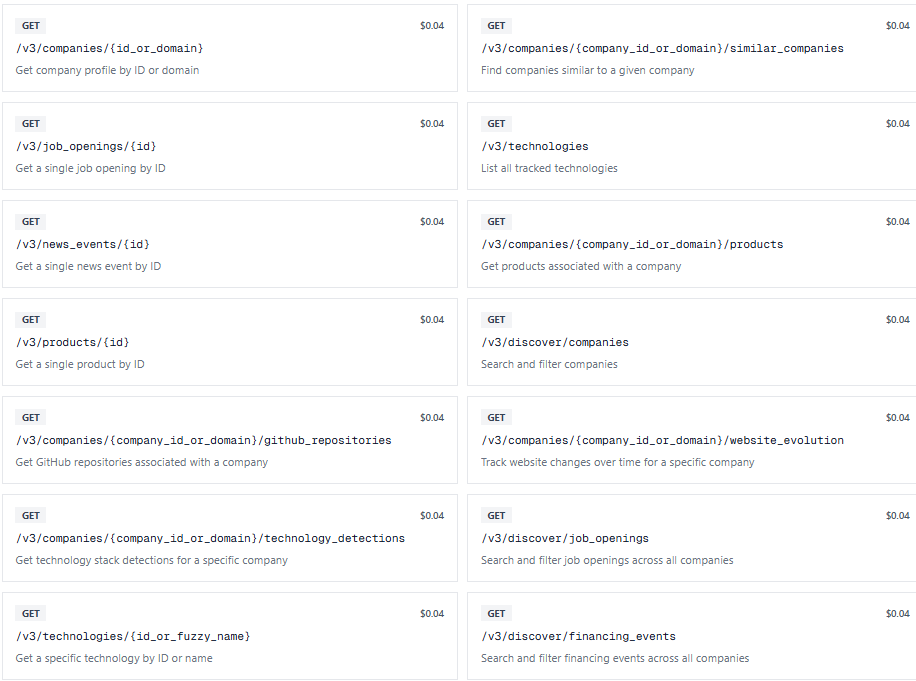
Example AI Workflow Using PredictLeads
Workflow Steps
An AI agent researching potential prospects could run the following workflow:
- Retrieve company profile
- Check hiring activity
- Detect technology stack
- Retrieve recent news events
- Check funding history
Example Output
Company: example.com
Signals detected:
- Raised Series B funding
- Hiring software engineers
- Adopted Snowflake
- Announced new partnership
The agent can then generate a company intelligence summary or rank the company as a top sales prospect.
Why Each Signal Matters
A Series B raise tells you the company has fresh capital and is likely weighing new vendors to support its next growth phase. Budget cycles reset after funding rounds, so reaching out within weeks of an announcement puts you in front of a buyer who is actively making purchase decisions instead of deferring them.
Hiring software engineers points to an active technical build-out. When a company posts multiple engineering roles in a short window, it is expanding its product or infrastructure, which often creates demand for tools, services, and integrations that did not exist on the roadmap six months earlier.
A Snowflake detection suggests the company is maturing its data infrastructure. Teams that adopt a cloud data warehouse are usually building out analytics, reporting, or machine learning workflows, and they tend to bring in complementary vendors – data quality tools, orchestration layers, or BI platforms – shortly after.
A new partnership announcement can signal ecosystem expansion. If a company is connecting with new distribution channels or technology partners, its buying committee may be growing and its needs shifting. For sales teams, a fresh partnership is a reason to re-engage accounts that went quiet.
When you combine all four signals in a single agent run, you move from a weak buying signal to a strong one. One signal is a hint; four overlapping signals pointing in the same direction give you the confidence to place that account at the top of your list instead of treating it as a maybe.
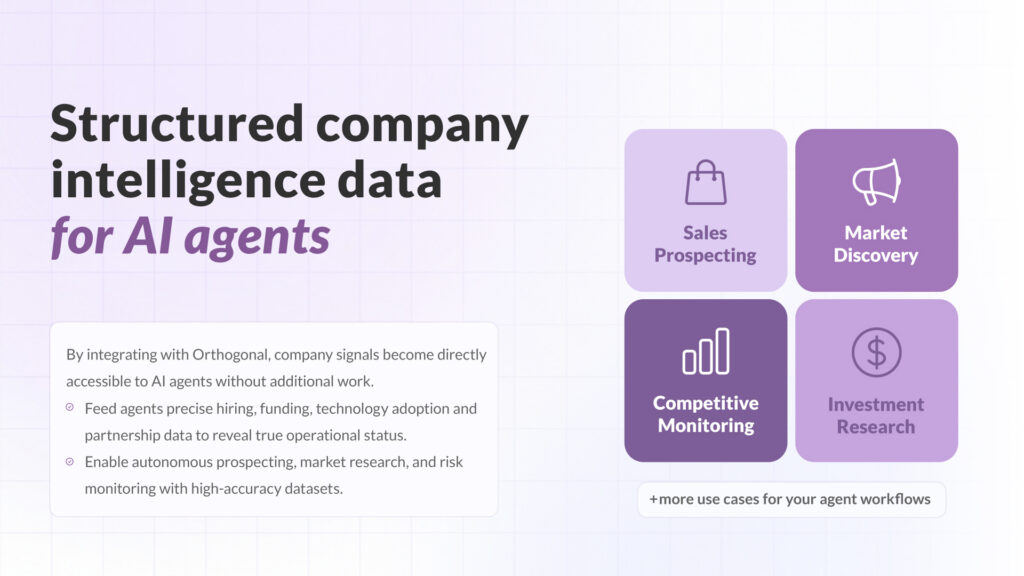
PredictLeads provides structured company intelligence signals that AI agents can use for sales prospecting, market discovery, competitive monitoring, and investment research through the Orthogonal platform.
Why This Integration Matters
AI agents require structured company signals to analyze markets and companies effectively.
PredictLeads provides these signals through datasets that track:
By integrating with Orthogonal, these datasets become directly accessible to AI agents without additional integration work.
Developers can use PredictLeads data inside agent workflows for:
- sales prospecting
- competitive monitoring
- investment research
- account intelligence
- market discovery
Sales and RevOps teams can replace manual research cycles with an agent that runs the lookup automatically. Instead of an SDR spending an hour scanning news and job boards before a call, the agent checks Financing Events, Job Openings, and News Events in sequence and surfaces a ranked summary. For example, you can configure an agent to flag every account in your CRM that raised a funding round in the last 90 days and has since posted SDR or account executive roles – those accounts are actively building a go-to-market motion and are a warm outreach target right now. The agent delivers that list to your queue daily without any manual checking.
Investment teams can run continuous monitoring across a watchlist of portfolio companies or prospects by pulling hiring velocity from Job Openings, new rounds from Financing Events, and technology changes from Technology Detections on a recurring schedule. Instead of an analyst manually reviewing each company before a weekly call, the agent aggregates the signals and surfaces only the accounts where something has changed. You get a structured feed of activity across dozens of companies without building a custom data pipeline.
Developers building AI products get a reliable, normalized data layer to reason over. PredictLeads returns structured JSON responses across coverage of 130.7M+ companies, so your agent receives consistent schemas instead of raw, unformatted text it has to parse and clean. That consistency makes it straightforward to build scoring logic, filtering rules, or summarization steps on top of the data without writing defensive parsing code for every endpoint.
The Orthogonal integration removes the setup barrier for all three groups. You connect once, and your agent can start querying company signals across any of these datasets immediately, without managing separate API keys or reading through multiple sets of documentation.
Why This Integration Matters More in September 2026
The context for this integration has shifted considerably since it launched. Research tracking 2026 sales trends finds that 54% of organizations are now deploying AI agents across the sales cycle, up from early-stage experiments just a year ago, and that high-performing teams are 1.7x more likely to use AI agents for prospecting than underperformers. The gap between teams that run structured, signal-triggered workflows and those relying on manual research is widening fast.
That shift makes the data layer underneath an AI agent more consequential than it was in 2025. An agent is only as good as what it can query. Agents pulling from normalized, source-linked datasets like PredictLeads can produce prioritization logic that a human rep can act on immediately. Agents pulling from inconsistent or unverified sources produce noise that erodes trust in the workflow over time.
PredictLeads also added a native PredictLeads MCP server at mcp.predictleads.com in 2026, giving AI agents a conversational interface to query company data – your agent describes what it needs in plain terms and the server maps that to the right endpoint, so you never write a REST call manually. The MCP server and the Orthogonal integration solve related but distinct problems: the MCP path is the faster choice when your agent runtime already speaks the Model Context Protocol (MCP) and you want a direct, single-provider connection to PredictLeads data. Orthogonal makes more sense when your agent needs to route across several data providers through one catalog and you want to avoid managing separate credentials for each. If you are building a focused GTM agent workflow on an MCP-compatible runtime, connect directly. If you are assembling a multi-source agent that pulls from a range of APIs, Orthogonal removes the per-provider overhead.
FAQ
What is Orthogonal and why does the PredictLeads integration with it matter for AI agent builders?
Orthogonal is an API catalog layer built for AI agents, letting them search for and call APIs by describing what they need instead of managing individual API keys and documentation sets. The PredictLeads integration means your agent can query Job Openings, Financing Events, News Events, Technology Detections, and Connections through a single connection point, with no separate auth flows or schema-mapping work per dataset.
What’s the best way to build a company intelligence layer for an AI sales agent in 2026 – PredictLeads direct API vs. PredictLeads through Orthogonal?
Use the PredictLeads API directly when you want full control over query logic, filtering parameters, and credit management inside your own infrastructure. Go through Orthogonal when you are building an agent that needs to find and call multiple data sources dynamically, because Orthogonal handles catalog routing and removes the per-provider setup overhead. PredictLeads returns the same normalized JSON either way, so your downstream scoring or summarization logic does not change.
How do I combine multiple PredictLeads signals in one AI agent run to rank accounts?
Call /v3/companies/{domain}/financing_events to check for a recent round, /v3/companies/{domain}/job_openings to confirm active hiring, /v3/companies/{domain}/technology_detections to assess stack fit, and /v3/companies/{domain}/news_events to catch partnership or expansion announcements. Each endpoint returns structured JSON with consistent field names, so you can write a single scoring function that reads across all four responses and flags accounts where three or more signals point in the same direction.
Can an AI agent find companies showing buying signals without knowing their domain names in advance?
Yes. PredictLeads discovery endpoints let you filter across the full dataset by signal type instead of by company. For example, GET /discover/financing_events returns recently funded companies filtered by round type and location, and GET /discover/job_openings returns companies hiring for a specific O*NET occupation code. Your agent can run these queries on a schedule and pass the resulting domains into company-level endpoints for deeper enrichment.
What data does PredictLeads return through the Orthogonal integration, and how current is it?
PredictLeads returns structured records across five datasets through Orthogonal: Job Openings, News Events, Technology Detections, Financing Events, and Connections. Job openings are refreshed approximately every 36 hours, high-traffic websites are crawled multiple times daily, and every record includes first_seen_at and last_seen_at timestamps so your agent can filter for signals that appeared within a set window instead of acting on stale data.
PredictLeads as the Intelligence Layer for AI Workflows
PredictLeads tracks structured signals across millions of companies.
Through the Orthogonal integration, these signals can now be accessed directly by AI agents.
This allows developers to build systems that automatically detect company activity and generate insights based on real-time business signals.
PredictLeads becomes the company intelligence layer powering AI-driven research and decision workflows.
Ready to see this in your own data?
Get 100 free API requests when you create an account – no credit card, no sales call.