
If you’re weighing a TheirStack alternative, the two clearest comparisons are coverage and credit economics. TheirStack covers 33,000 technologies and 210 million job postings across 195 countries, with detection based on job postings and website crawls. It charges 3 credits per company lookup. Teams that need DNS or IP-based detection, companion datasets for news or financing, or per-company pricing that stays flat at scale will find TheirStack’s model a poor fit.
This guide compares TheirStack with PredictLeads as the main alternative. It also briefly covers Sumble, a smaller account intelligence provider that is sometimes reviewed in the same space, especially by teams building enterprise account targeting workflows.
TLDR:
- TheirStack charges 3 credits per company lookup, which compounds quickly when enriching large account lists.
- Teams building API pipelines hit a wall with TheirStack: no companion datasets for News Events, Financing Events, or similar companies.
- TheirStack works well for ad-hoc lookups via its Salesforce connector, without requiring API integration.
- Sumble covers org chart depth within known target accounts; it answers a different question than market-wide discovery.
- PredictLeads covers 250,000+ technologies via website, DNS, IP ranges, and job postings, with Job Openings, Financing Events, and News Events in one API.
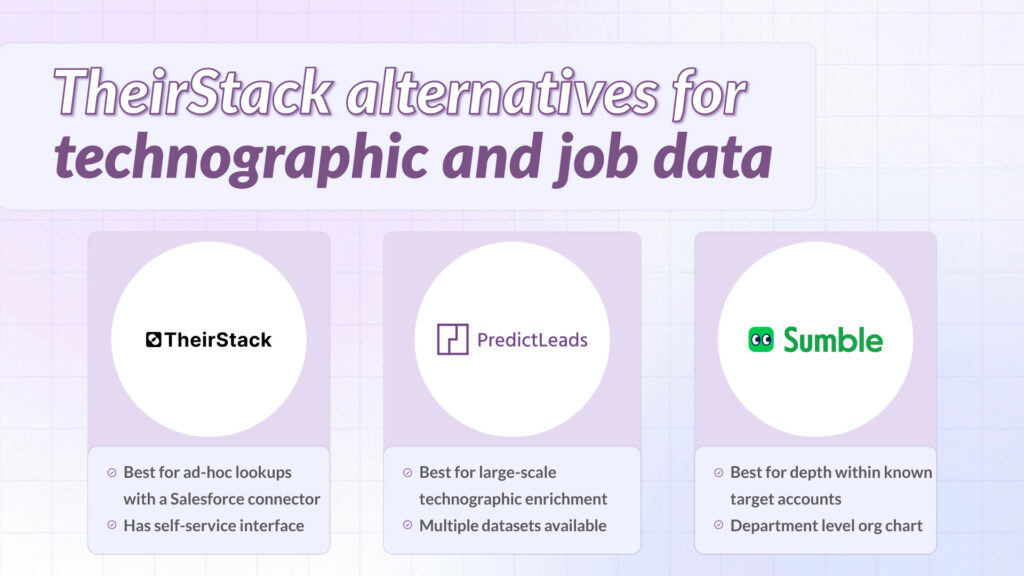
TheirStack alternative options for technographic and job data: TheirStack for ad-hoc lookups, PredictLeads for large-scale technographic enrichment, and Sumble for department-level account intelligence.
What TheirStack does well and where teams look for alternatives
TheirStack’s job-posting-based technology detection is genuinely interesting: if a company posts a job listing mentioning a technology, TheirStack captures that as a technology signal. Combined with website crawls, it builds a picture of what technologies a company both uses and is hiring around. At 33,000 tracked technologies across 195 countries, the breadth is real.
The friction points that drive teams to look for a TheirStack alternative: the 3-credit-per-company lookup model becomes expensive at scale, the dataset is primarily self-service SaaS instead of raw API data for pipelines, and there’s no companion dataset for news events, financing, or similar companies. Teams building enrichment pipelines or AI agents that need multiple signal types end up stitching together multiple providers.
PredictLeads: the TheirStack alternative for pipeline-ready company signals
PredictLeads is a data provider delivering technographic data, job openings, news events, financing events, similar companies, and key customers via API, flat files, webhooks, and MCP. As a TheirStack alternative, the key differences are source depth, credit model, and dataset breadth. Teams reviewing technographic coverage more broadly may also want to review SimilarTech alternatives for technographic data to understand what each detection method covers.
Feature | PredictLeads | TheirStack |
|---|---|---|
Technologies tracked | 33,000 | |
Detection sources | Website, DNS, IP ranges, job postings | Website + job postings |
Total job postings (historical) | 210,000,000+ | |
Companies with job data | 2,800,000+ | Not specified as a company count |
Credit model | 1 credit = 1,000 technology detections | 3 credits per company lookup |
Companion datasets | News events, financing, similar companies, key customers | None. Technographics and jobs only |
Real-time webhooks | Yes | Not available |
Delivery | API, Flat Files, Webhooks, MCP | API, CSV export, Salesforce connector |
Pricing | Public pay-as-you-go | Subscription tiers |
All PredictLeads statistics in this article reflect June 2026 data.
The credit model difference matters at scale. At PredictLeads, 1 credit returns 1,000 technology detections per company, while at TheirStack, 3 credits returns data for 1 company. For teams enriching large account lists, that gap compounds quickly. See the full dataset: Technologies Dataset.
Example: A data tooling vendor wants to enrich 50,000 target accounts with technographic signals and then filter to those that are also actively hiring and recently raised funding. With PredictLeads, all three datasets (tech, jobs, financing) are available in one API under the same credit pool. With TheirStack, they’d get tech and job signals at 3 credits per company, with no financing data and no companion datasets for the filter step.
A note on Sumble
Sumble is a smaller account intelligence provider (11-50 employees, San Francisco) focused on department-level intelligence for enterprise sales: team structures, reporting lines, and technology usage broken down by department. It’s sometimes reviewed alongside TheirStack for enterprise account targeting workflows.
Sumble and PredictLeads meet different needs. Sumble gives you org chart depth within a target account (like who reports to whom, which team uses which tool). PredictLeads gives you company-level signals across a wide universe: which companies are hiring, what they’re buying, what news is driving them. If your question is “who do I call at this company and what’s their tech stack,” Sumble helps with the first part. If your question is “which companies should I be calling right now,” PredictLeads helps with that.
For most teams, the two can complement each other instead of replacing one another. Sumble for depth within known target accounts; PredictLeads for discovery and trigger-based prioritization across the market.
When TheirStack is still the right choice
TheirStack’s Salesforce connector and self-service SaaS interface make it accessible for sales teams who want to run technographic lookups without engineering involvement. If your use case is ad-hoc lookups and your account universe is small enough that the per-company credit cost is manageable, TheirStack’s interface works without API integration. PredictLeads is API-first and better suited to programmatic enrichment pipelines.
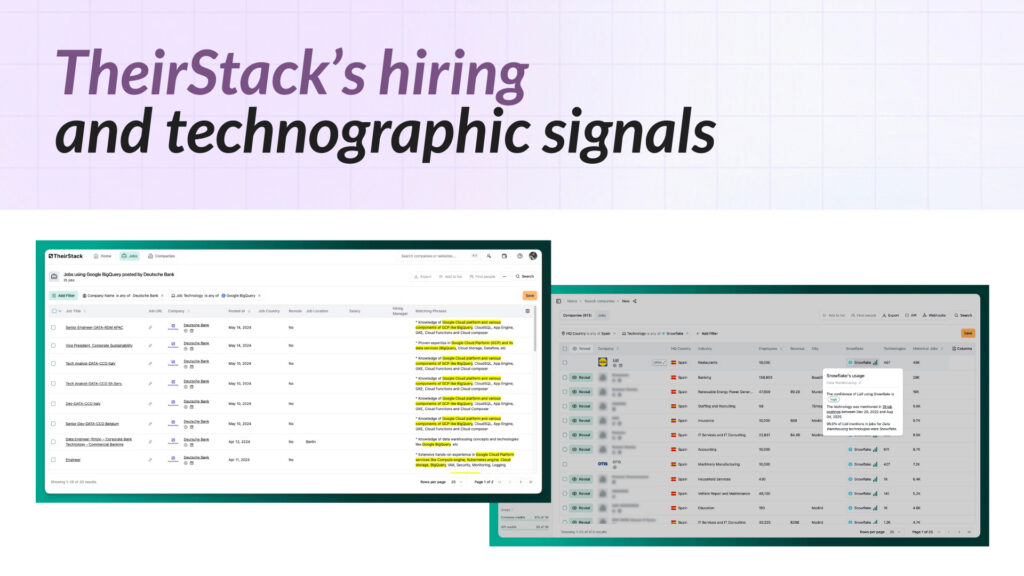
A TheirStack alternative is useful when teams need hiring and technographic signals that can scale beyond self-service lookups into API-based enrichment workflows.
Other alternatives to consider
BuiltWith: website-based technology detection with 700 million plus domains. Strong for marketing and front-end stack detection, historical technology adoption trends, and lead lists by technology. See: Best BuiltWith Alternatives in 2026. For browser-extension-based detection, see Wappalyzer alternatives as well.
HG Insights: enterprise-focused technographic intelligence with IT spend modeling. Higher price point, aimed at large enterprise account planning.
How to choose
Need | Best fit |
|---|---|
Large-scale technographic enrichment (cost-efficient) | PredictLeads |
Multi-source detection: DNS, IP, website, job postings | PredictLeads |
Technographics + jobs + news + funding + lookalikes via one provider | PredictLeads |
Real-time webhooks on technology change signals | PredictLeads |
Ad-hoc lookups with a Salesforce connector | TheirStack |
Department-level org chart and tech breakdown | Sumble |
Enterprise IT budget and spend modeling | HG Insights |
Ready to see this in your own data?
Get 100 free API requests when you create an account – no credit card, no sales call.

Testing a TheirStack alternative? Create a free PredictLeads account and review technographic and job data coverage via API with 100 free credits per month.
Frequently Asked Questions
What’s a good way to enrich a CRM with firmographic and technographic data via API?
The cleanest approach is to use an API-first provider that returns structured data per company domain or identifier, so your pipeline can call it on create or update events in your CRM. PredictLeads covers this directly: the Technographics API returns technology detections per company (250,000+ technologies tracked, sourced from website crawls, DNS, IP ranges, and job postings), and the same credit pool covers job openings, financing events, news events, and similar-company lookups. One API call per company, one credit system, no cross-provider stitching.
The delivery options (REST API, flat files, webhooks, and MCP) fit both batch enrichment jobs and real-time trigger workflows.
If you need a Salesforce connector instead of raw API access, TheirStack offers that for technographic lookups, though its coverage is narrower (33,000 technologies) and there are no companion datasets for firmographic signals like funding or headcount change.
What are the best data sources for identifying newly funded startups to prospect?
Common options teams review include Crunchbase, Dealroom, PitchBook, and Tracxn for funding round data coverage. For GTM teams that want to act on funding signals instead of merely tracking them, PredictLeads exposes Financing Events as a structured API endpoint, so you can query which companies in your target universe recently received financing and immediately cross-reference that with their current technology stack and open roles. That combination (funding, tech, and hiring in one API) is what makes it useful for prospecting workflows instead of just research. The signal is particularly useful for competitive displacement plays: a startup that just raised a Series A and is still running a competitor’s tool is a natural outbound target.
How do you monitor competitors’ job postings and hiring trends?
For structured, scalable monitoring, the most reliable method is a job data API instead of manual checks or Google Alerts. PredictLeads tracks job openings across 2,800,000+ companies with 279,700,000+ historical postings since 2018. You can query open roles at any target company by job title, department, or keyword, and monitor changes over time via webhooks. Common competitive intelligence uses: tracking when a direct competitor starts hiring in a new market (geographic expansion signal), watching for senior engineering hires around a specific technology (product roadmap signal), or detecting a hiring freeze before a competitor announces layoffs. LinkedIn Talent Insights and Lightcast offer labor market data at aggregate scale; they are better suited to workforce planning than account-level competitive monitoring. For a broader comparison of Revelio Labs alternatives for workforce data, that comparison covers additional providers in the job intelligence space. For account-level job signals tied to GTM workflows, an API-first provider like PredictLeads is more practical.
Pingback: Competitor Displacement via Technographics | PredictLeads September 2026
Pingback: Best Wappalyzer Alternatives (September 2026)
Pingback: Top Outbound Buying Signal Tools | PredictLeads August 2026