
To find companies hiring data engineers while adopting new data tools, you filter job openings for data roles (data engineer, analytics engineer, data platform engineer), check technology detections for recently adopted data tools such as cloud warehouses or BI tools, and rank accounts where both changes happen in a similar window. A static firmographic list of every company with 200 to 2,000 employees is large, but it tells you nothing about timing.
PredictLeads has collected more than 300 million historical job openings since 2016 and averages 9.8 million active openings at any time. Its technology dataset holds more than 2 billion technology detections across 250,000+ tracked technologies. At that scale, you query structured records across millions of companies instead of guessing which accounts are worth a look.
TLDR
- You filter Job Openings for data roles: data engineer, analytics engineer, and data platform engineer.
- You check Technology Detections for recently detected data tools, such as cloud warehouses or BI tools.
- You rank accounts where both first_seen_at dates fall in a similar window.
- You push the ranked accounts, along with the reason, into your CRM or outbound workflow.
Why This Signal Matters
A company hiring data engineers is already showing a useful signal, the same logic behind treating hiring as a buying signal. They may be building infrastructure, scaling analytics, improving reporting, modernizing pipelines, or supporting new AI and data products.
A company adopting new data tools is also showing a useful signal. It may be changing its stack, moving workloads, expanding analytics capabilities, or replacing older systems.
Together, those two signals carry more weight than either one alone.
Hiring data engineers while adopting new data tools suggests that the company is investing in data transformation, not talking about it. It is adding people and systems at the same time.
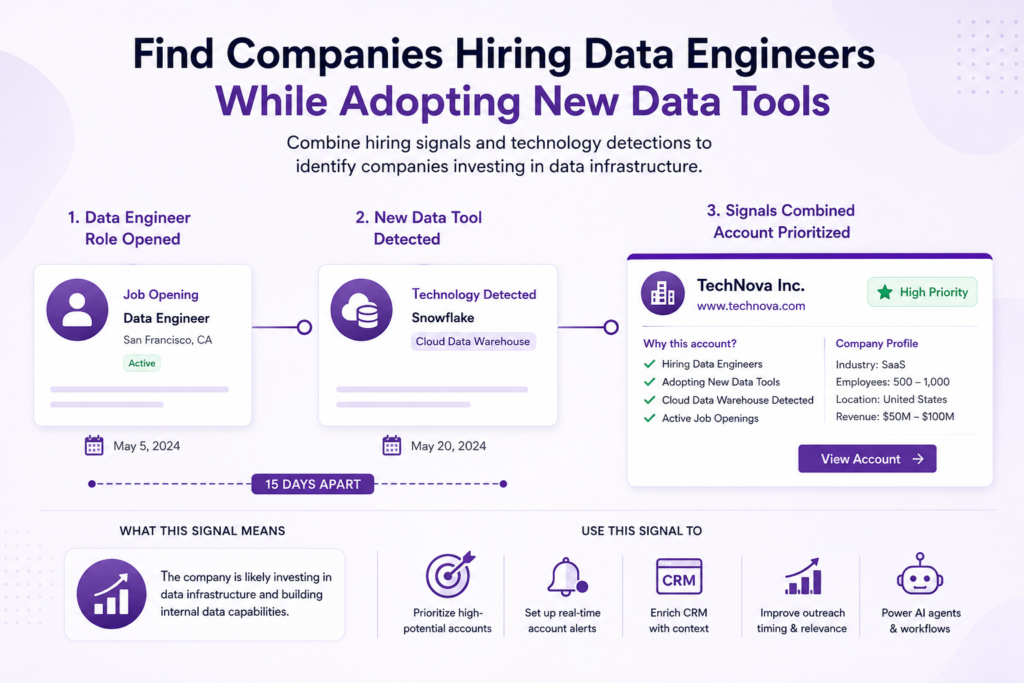
The illustration traces one account through the sequence: an active data engineer opening appears, a new data tool gets detected soon after, and the pair of events pushes that account to the top of a ranked list with company profile context attached. That overlap gives a rep a specific reason to reach out instead of a generic cold call.
The Signal Logic
The workflow is simple:
- Find companies with active job openings for data engineers or adjacent roles.
- Check whether those companies are using or adopting relevant technology categories.
- Filter for company size, location, industry, or ICP fit.
- Rank accounts where hiring and technology changes happened close together.
You compare the first_seen_at date of the data role opening with the first_seen_at date of the technology detection, and you rank an account higher when both dates fall inside a window you choose, for example, the same 90 days. Treat the 90 days as an example filter setting you can adjust, not a fact about buyer behavior.
A job post is one clue, and a technology detection is another. Together, they can indicate a company actively building a data function.
Benefits and Limitations of This Signal
Pros
- Surfaces investment before it is public. A new data engineer opening can appear before any press release about a data initiative.
- Shrinks a broad ICP list to higher-fit accounts that show both hiring and tooling activity.
- Gives reps an explainable reason for each account’s rank.
Cons
- Not a guaranteed buying signal on its own (see the FAQ below on whether hiring a data engineer is always a buying signal).
- Hiring data can lag when companies post late or leave old listings open.
- Technology Detections provide evidence of use and can include false positives, so confirm with a second signal.
Roles to Track
| Role Type | Why It Matters | Example Searches |
|---|---|---|
| Data Engineer | Pipeline and infrastructure investment | data engineer, analytics engineer, platform data engineer |
| Analytics Engineer | Modern BI and transformation workflows | analytics engineer, dbt engineer |
| Data Platform Engineer | Internal data platform buildout | data platform engineer, data infrastructure engineer |
| Machine Learning Engineer | AI and model infrastructure | ML engineer, AI platform engineer |
| Data Governance Roles | Compliance and data quality programs | data governance, data quality, data steward |
You can run these searches against about 9.8 million active job openings in the PredictLeads Job Openings dataset, filtering by categories such as data_analysis, software_development, and engineering plus seniority, so a search for “analytics engineer” at mid_senior level returns current openings instead of stale postings.
Technology Categories to Watch
Do not limit this workflow to one named vendor unless your sales motion depends on it.
Start with technology categories from a technographics dataset:
- Cloud data warehouses
- BI and analytics tools
- Reverse ETL and activation tools
- Data observability tools
- Customer data tools (CDPs)
- Workflow and automation tools
- AI infrastructure and model tooling
If you sell into a specific ecosystem, narrow the query further.
For example, a vendor that integrates with Snowflake, BigQuery, Databricks, Looker, or dbt may want to track those exact technologies.
Example GTM Workflow
Imagine your company sells a data quality tool.
A broad ICP list might include every SaaS company with 200 to 2,000 employees.
That list is too big.
A signal-based list narrows that set to companies hiring for data roles and showing evidence of new data tooling. Here is how the two approaches compare:
Criteria | Traditional Static Lead List | Signal-Based Lead List (Hiring + Technology) |
|---|---|---|
List size | Every SaaS company with 200 to 2,000 employees, often thousands of accounts | Only the accounts from that same list that have an active data role opening and a data tool first detected inside your chosen window (for example, the last 90 days) |
Relevance and precision | Fit on size and industry alone | Accounts hiring data engineers or analytics engineers and showing evidence of new cloud data warehouse or BI tooling |
Cost of outreach | Reps spend hours researching accounts with no visible need | Each account arrives with a reason to reach out, so research time drops |
Timing accuracy | No indication of when a company is investing | Active job openings and recent detections point to a current initiative |
Data freshness | Often a one-time export that ages quickly | Active openings instead of historical postings, recent first_seen_at dates, plus optional news or funding momentum |
Geography and ICP fit | Filtered by location and size | The same filters for your target markets, applied on top of the signals |
That list is smaller, but much more useful. (and cost less due to time spent of finding the right company)
Practical Signal Workflow
- Define the target motion
Identify companies investing in data infrastructure. - Select hiring signals
Track data engineers, analytics engineers, ML engineers, and related roles. - Add technology signals
Monitor cloud warehouses, BI tools, CDPs, reverse ETL tools, and AI infrastructure. - Filter by ICP
Apply company size, industry, geography, and account criteria. - Combine signals
Rank companies where hiring and technology adoption occurred within a similar timeframe. - Activate workflows
Push results into CRM systems, sales intelligence tools, AI agents, or outbound lead generation campaigns. - Review and refine
Measure conversion rates and adjust signal criteria over time.
How Data Providers Can Use This
Data providers and sales intelligence products can turn this signal into:
- Account scoring fields
- Weekly account alerts
- Territory prioritization lists
- CRM enrichment
- AI-generated account summaries
- Trigger-based outbound workflows
The important part is explainability.
A rep should see more than a high account score.
They should also understand why:
“Hiring two data engineers and detected new analytics tooling.”
How PredictLeads Supports This Workflow
You can build this workflow from three PredictLeads datasets, each available through the API, flat files, webhooks, and MCP. It also tracks 50,000 technologies and has detected 1.3 billion technology adoptions since 2018.
For this workflow, the most relevant datasets are:
Job Openings Dataset
Use:
GET /companies/{company_id_or_domain}/job_openingsGET /discover/job_openings
Technology Detections Dataset
Use:
GET /companies/{company_id_or_domain}/technology_detectionsGET /discover/technologies/{technology_id_or_fuzzy_name}/technology_detections
Companies Dataset
Use:
GET /companies/{id_or_domain}GET /discover/companies
The Companies dataset returns firmographic fields such as company name, structured location, NAICS codes, revenue range, employee min and max, parent and subsidiary companies, and lookalike companies, so you can filter the hiring and technology results by ICP fit. Once you have a list of target accounts, you can pass the company domains into the contact enrichment tool already in your GTM stack to find the data, analytics, or engineering leaders to contact.
Teams can consume the data through:
- APIs
- Flat files
- Webhooks
Depending on whether the workflow requires real-time alerts, batch enrichment, or product integrations.
Frequently Asked Questions
Is Hiring a Data Engineer Always a Buying Signal?
No.
It is a company signal, not guaranteed intent. It becomes more useful when combined with technology adoption, funding, expansion, or other company signals.
Should I Track Exact Job Titles or Broad Categories?
Start with categories, then refine by title.
Exact titles reduce noise, but broader categories can reveal patterns you might otherwise miss.
How Recent Should the Signal Be?
For GTM prioritization, recent active openings are usually more valuable than stale historical openings.
Historical data remains useful for trend analysis.
How Can I Access This Data?
You can pull the Job Openings and Technology Detections datasets through the API, flat files, webhooks, or MCP, depending on whether you need real-time alerts or batch enrichment. Visit the dataset pages above for pricing and trial details. New accounts receive a one-time $20 in free credits (500 credits at the $0.04 starting rate) to test the data. Pricing is prepaid, pay-as-you-go credits with no subscription or monthly minimum.
Can This Workflow Support AI Agents?
Yes.
AI agents can use structured hiring and technology signals to:
- Search accounts
- Explain account priority
- Trigger workflows
- Generate account summaries
Find Companies Investing in Data Infrastructure
Companies hiring data engineers while adopting new data tools often reveal data modernization initiatives before they become obvious to the market.
By combining hiring and technology signals, GTM teams can focus on accounts that are actively building data capabilities instead of relying on static firmographic filters.
Use the PredictLeads Job Openings Dataset and Technology Detections Dataset to find companies hiring into specific roles while adopting relevant tools.
Ready to see this in your own data?
Start with $20 in free credits when you create an account – no credit card, no sales call.
Pingback: Average Tech Stack by Funding Stage (2026 Data
Pingback: BuiltWith Alternatives Sept 2026