
Choosing a technographic data provider goes beyond finding a list of companies using a specific tool. B2B teams need technology data that is accurate, fresh, structured, and easy to use inside sales, marketing, enrichment, and product workflows.
Technographic data helps teams understand what technologies a company appears to use. That context can support segmentation, partner targeting, competitive displacement, account scoring, and personalization. Research on technographic data suggests that technology stack data can help B2B teams segment and target accounts with more precision. But the value of the data depends heavily on how the provider collects, verifies, updates, and delivers it.
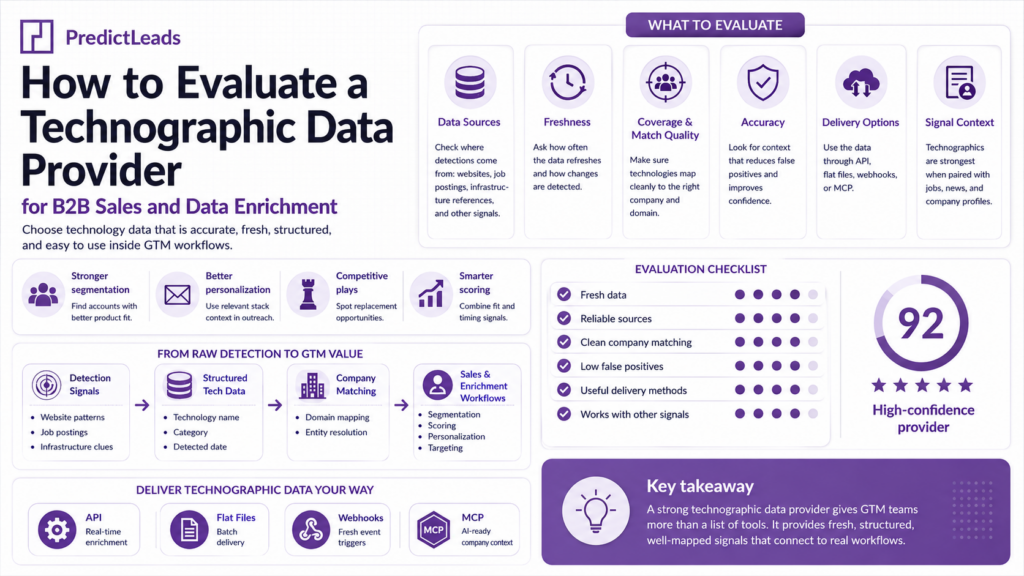
Assess a technographic data provider by checking sources, freshness, accuracy, delivery, and coverage.
TLDR:
- Assess a technographic data provider on six criteria: sources, freshness, coverage, accuracy, delivery, and signal integration.
- Multi-source detection (website, job postings, and infrastructure signals) can produce fewer false positives than website-only detection in many cases.
- Require
first_seen_atandlast_seen_attimestamps on every detection: monthly or slower refreshes without timestamps are a red flag.- Test match quality by running 50 to 100 of your own accounts through a trial before committing to any vendor.
- PredictLeads covers 98M+ company domains and tracks 250K+ technologies, with Technology Detections joinable to Job Openings and News Events.
Criterion | What to Ask | Red Flag |
|---|---|---|
Data Sources | Which sources back each detection? | Only website scripts, with no source links. |
Freshness/Update Frequency | How often does data refresh, and are first_seen_at and last_seen_at timestamps included? | Monthly or slower refreshes with no timestamps. |
Coverage & Match Quality | How many domains and technologies are covered, and do they map to the right company? | Records matched to the wrong domain. |
Accuracy & False Positives | How does the provider separate real usage from stray traces? | No evidence or confidence context per detection. |
Delivery Options (API, flat files, webhooks, MCP) | Which delivery methods fit your workflow? | Only a UI or one-off CSV export. |
Integration with Other Company Signals | Can you join detections with hiring, news, and company data? | Technology data sits isolated from other signals. |
What does a technographic data provider do?
A technographic data provider identifies technologies used by companies and turns those signals into structured data. This can include software, platforms, scripts, infrastructure signals, analytics tools, ecommerce systems, marketing tools, payment tools, and other detectable technologies.
For PredictLeads, technology detection is part of a broader company intelligence layer. The Technologies Dataset can be combined with hiring activity, company news, similar companies, and company profiles to create a more complete account view.
This article focuses on evaluation criteria for B2B data enrichment workflows. For the broader vendor comparison, read our guide to the best technographic data providers for B2B targeting in 2026. For the main definition page, start with What Is Technographic Data?.
Start with the data sources
The first question is simple: where does the technographic data come from?
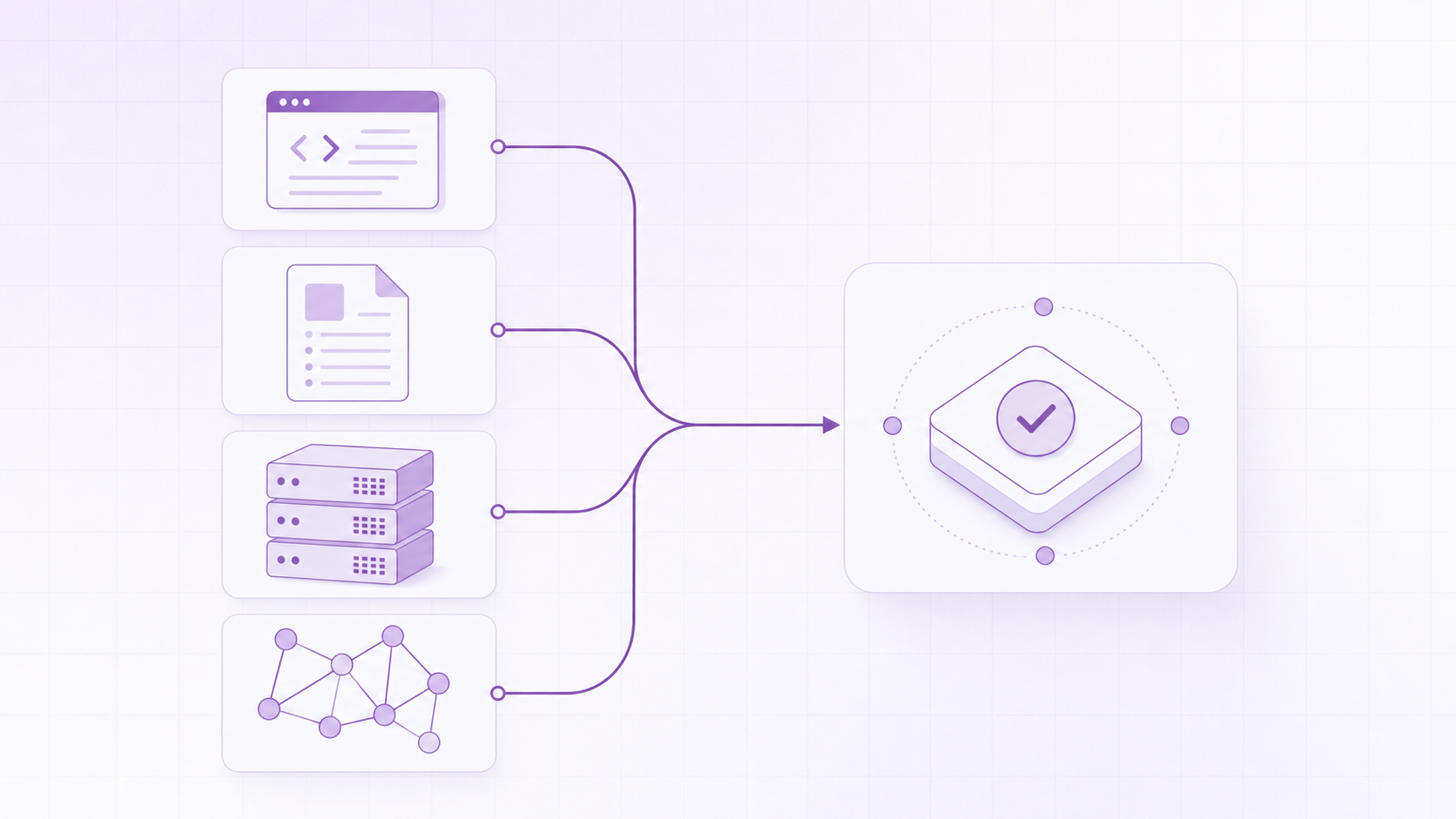
Some providers rely mainly on website detection. Others combine multiple sources. Website detection reads fingerprints: markup patterns, HTTP headers, and embedded scripts that resolve to known vendor endpoints. Providers match those signatures against a maintained catalog of known technologies, and stronger providers also assign a confidence score to each detection instead of treating every match as equally certain. Ask vendors how they handle fingerprint matching and confidence scoring, since both determine how many false positives reach your enrichment workflow.
For example, a static script on a website may suggest that a company uses a tool, but it may not always prove active usage. Signals become more useful when they are supported by multiple forms of evidence, such as website patterns, job postings, infrastructure references, and other company activity. Weigh the trade-offs between the two approaches:
- Website-only detection, pros: fast to run, simple to understand, and good at spotting publicly visible tools.
- Website-only detection, cons: higher false-positive risk, and a script trace alone cannot confirm active usage.
- Multi-source detection (website, job postings, infrastructure signals, and company activity), pros: higher confidence and fewer false positives, because several signals back each detection.
- Multi-source detection, cons: more complexity to interpret and potentially higher cost.
Check freshness
Technology stacks change. Companies remove tools, adopt new platforms, migrate infrastructure, and test vendors. Old technographic data can lead sales teams into weak personalization and poor targeting.
When assessing a technographic data provider, ask how often the data refreshes, how changes are detected, and whether historical data is available. Freshness matters most when the data supports active sales plays, enrichment, scoring, or product workflows.
As a rough benchmark, daily or weekly refreshes suit most outbound and lead scoring workflows, while monthly or slower cycles are harder to use for timed plays. Look for per-detection first_seen_at and last_seen_at timestamps so you can see when a technology appeared and when it was last detected. For reference, PredictLeads timestamps every Technology Detection this way and, per its Technologies dataset page, has recorded 93M+ detections in the last month.
Check coverage and match quality
Coverage matters, but broad coverage is not enough. The data also needs to match the right company domain and entity. If technology signals are not mapped cleanly to companies, teams can end up enriching the wrong records.
This is why technographic data should connect well with company profiles. The Companies Dataset can provide the base company layer, while the Technologies Dataset adds stack-level context.
As a benchmark for any vendor, look for domain coverage in the tens of millions or more, and a technology catalog in the tens of thousands or higher, since a catalog of only a few thousand technologies tends to miss niche tools. For reference, PredictLeads covers 98M+ company domains and tracks 250K+ technologies. Test match quality yourself by running 50 to 100 of your own accounts through a trial and checking how many map to the correct domain and technologies.
Benchmark | What to Look For | PredictLeads Reference |
|---|---|---|
Refresh cadence | Daily or weekly refreshes for outbound and scoring workflows | 93M+ Technology Detections recorded in the last month |
Timestamps |
| Both timestamps on every Technology Detection |
Domain coverage | Tens of millions of domains or more | 98M+ company domains |
Technology catalog | Tens of thousands of technologies or more | 250K+ technologies tracked |
Match quality | Trial run of 50 to 100 of your own accounts, checking domain and technology matches | Each detection links back to its original source, so you can verify matches |
Assess accuracy and false positives
Accuracy is one of the hardest parts of technographic data. A company may have traces of a tool on its website without actively using it in the way a GTM team assumes. A job posting may mention a technology because the company is hiring for that skill, but it still needs context.
The best approach is to treat technographic data as a signal, not a magic answer. Strong providers give enough context for teams to make confident decisions and combine technologies with other signals.
Consider a company whose website still loads a legacy analytics script months after it moved to a different tool. A provider that checks only the page will keep reporting the old tool as current. A job posting can mislead in the other direction: it may mention a CRM platform because the company is weighing a switch, not because the CRM is already in use. Ask each vendor how it validates detections and whether every record carries first_seen_at and last_seen_at timestamps, so you can tell a recent detection from a stale one. A technology that has not been detected since a given date is a prompt to check, not proof that the company dropped it.
Look at delivery options
A technographic data provider should support the way your team works. Product teams may need an API. Data teams may prefer flat files. Revenue teams may need webhooks or CRM enrichment workflows. AI teams may want MCP access so agents can use company intelligence inside research and writing tasks.
Delivery matters because even accurate data creates little value if teams cannot use it easily. Check that the provider documents each delivery method clearly. The PredictLeads documentation covers the API, webhooks, and MCP integration, so you can review the schema and endpoints before you commit.
Use technographics with other company signals
Technographic data becomes more useful when it is combined with other business activity. A company using a specific platform is interesting. A company using that platform while hiring for related roles, expanding a team, and announcing new initiatives is much more interesting.
That is why teams often combine the Technologies Dataset with the Job Openings Dataset and News Events Dataset. Together, those signals can show stack fit, day-to-day business need, and timing.
Frequently Asked Questions
What is a technographic data provider?
A technographic data provider identifies the technologies companies use and turns those signals into structured data for sales, marketing, enrichment, and GTM workflows.
How should you assess a technographic data provider?
Assess a technographic data provider by checking data sources, freshness, coverage, accuracy, false positive handling, company matching, and delivery options such as API, flat files, webhooks, or MCP.
Why does technographic data matter for B2B sales?
Technographic data helps B2B sales teams find companies using relevant tools, identify replacement opportunities, personalize outreach, and rank accounts with stronger product fit.
What is a good way to enrich a CRM with firmographic and technographic data via API?
Use the company domain as the join key. Pull firmographics (description, location, NAICS codes, revenue range, and headcount) from the PredictLeads Companies endpoint, then request the same domain’s Technology Detections and write both sets of fields to the CRM account record. Store first_seen_at and last_seen_at alongside each technology so reps can see how recent the evidence is. Run the job on a schedule for existing accounts, and follow high-priority companies with webhooks so new detections reach the CRM as they appear. If you prefer no-code, Clay, Make, and n8n all have PredictLeads modules. Treat each detection as evidence of use, not confirmation of an active install.
Final takeaway
A good technographic data provider should give B2B teams more than a list of tools. It should provide fresh, structured, well-mapped technology signals that connect to real GTM workflows.
When assessing providers, focus on sources, freshness, coverage, accuracy, delivery, and how well the data connects with broader company intelligence. That is what turns technographic data from a static field into a useful revenue signal.
- Sources: How many independent signals confirm each detection?
- Freshness: How often does data refresh, and does each record carry first_seen_at and last_seen_at timestamps?
- Coverage: How many domains and technologies are covered, and do records map to the right company?
- Accuracy: How do you separate real usage from stray traces?
- Delivery: Can you get the data through API, flat files, webhooks, or MCP?
- Integration: Can you join detections with hiring, news, and company data?
Pingback: SimilarTech Alternatives 2026 | PredictLeads